Showing posts with label Planetary Prince. Show all posts

Thursday, November 5, 2020

Books of the Earth Chronicles..Book 1: The 12th Planet...The Endless Beginning...The Sudden Civilization...Gods of Heaven and Earth...Sumer: Land of the Gods

 Prologue


Mr. Sitchin’s words will appear in quotation marks (" "). Quotation marks within quotation marks indicate Mr. Sitchin is quoting others.


May I remind the reader, that this attempt to expose Mr. Z. Sitchin’s work, in my opinion magnificent, is to present his work as it is. No outside comments are required to interpreter his work, letting Mr. Sitchin, interpret Mr. Sitchin.

However, study of the same is a must, and if disagreement arises, then please research through the right sources to produce the right understanding, and so avoid listening unfounded speculations.

I am no scholar, but I am a member of Mankind in search for answers, and I believe Mr. Zecharia Sitchin has set a valuable opening for others to continue in the quest!

Following is an excerpt from the Prologue:


"This book suggests that we are not alone in the solar system. Yet it may enhance rather than diminish the faith in a universal Almighty for, if the Nefilim created Man on Earth, they may have only been fulfilling a vaster Master Plan"

New York, February 1977

A better opening to Zecharia Sitchin’s work could not be found. In his own words he has described the essence of his work. It is in this spirit that his books ought to be read, for the universal Almighty, no matter how you call it is the same spirit in us, non physical, and yet its latency is much felt if we connect!

Please Note: Unquoted sentences are mine, either joining extracts from the book, or a comment in like manner as the above.

Chapter One
THE ENDLESS BEGINNING

Evolution?

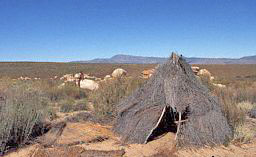
".....It is now recognized that in the normal course of evolution Man should still be typified by the Bushmen and not by us. It took Man some 2,000,000 years to advance in his "tool industries" from the use of stones as he found them to the realization that he could chip them and shape stones to better suit his purposes. Why not another 2,000,000 years to learn the use of other materials, and another 10,000,000 years to master mathematics and engineering and astronomy?

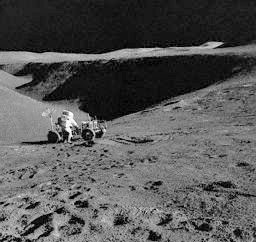
Yet here we are, less than 50,000 years from Neanderthal Man, landing astronauts on the Moon.

Apollo 15 Astronaut with Lunar Vehicle on Moon.

San hut at Kagga Kamma, "The Bushman Place," South Africa


Chapter Two

THE SUDDEN CIVILIZATION

Rosetta...
.

" When Napoleon arrived in Egypt in 1799, he took with him scholars to study and explain these monuments (pyramids, temple-cities half buried in the sands, guarded by strange stone beasts called sphinxes). One of his officers found near Rosetta a stone slab on which was carved a proclamation from 196 B.C. written in the ancient Egyptian pictographic writing (hieroglyphic) as well as in two other scripts.

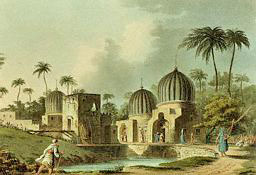
A Capture of a village near Rosetta, by Luigi Mayer.

"The decipherment of the ancient Egyptian script and language, and the archaeological efforts that followed, revealed to Western man that a high civilization had existed in Egypt well before the advent of the Greek civilization. Egyptian records spoke of royal dynasties that began circa 3100 B.C. - two full millennia before the beginning of Hellenic civilizations. Reaching its maturity in the fifth and fourth centuries B.C. Greece was a late comer rather than an originator.


"Was the origin of our civilization, then, in Egypt?

Mr. Z. Sitchin answers this question along his book.

"One of the greatest finds of Akkadian texts were the ruins of a library assembled in Nineveh by Ashurbanipal; Layard and his colleagues carted away from the site 25,000 tablets, many of which were described by the ancient scribes as copies of "olden texts". A group of twenty tablets ended with the statement: "23rd tablet: language of Shumer not changed....."

"...Except for mispronouncing the name - it should have been Shumer, not Sumer - Oppert was right (January 1869 Jules Oppert). Sumer was not a mysterious, distant land, but the early name for southern Mesopotamia, just as the book of Genesis had clearly stated: The royal cities of Babylon and Akkad and Erech were in "the Land of Shin’ar." (Shinar was the biblical name for Shumer).

"The first significant excavation of a Sumerian site was begun in 1877 by French archaeologists and the finds from this single site were so extensive that others continued to dig there until 1933 without completing the job.

Mr. Sitchin dedicates extensive research on the subsequent findings, and has included graphics of seals, cuneiform writings, clay tablets, and pictures in his book. These speak of the rulers of Sumer and their customs as a civilization.

"As masterful as even the first Sumerian temples were, they represent but the tip of the iceberg of the scope and richness of the material achievements of the first great civilization known to Man

The Sumerians invented writing and printing, the forerunner of our rotary presses, the cylinder seal.

More than with the divine and spiritual they concerned themselves with crops, measuring fields, calculating prices. They had a parallel system of mathematics.

They invented the kiln.
They achieved textile and clothing industries.
They were well achieved in agriculture.
Their culinary art was admirable:

cereals were turned into flour, to produce leavened and unleavened breads, porridges, pastries, cakes, and biscuits. Barley was also fermented to produce beer. Wine was obtained from grapes and date palms. Milk was available from sheep, goats, and cows, it was used as beveridge, for cooking and for converting into yogurt, butter, cream and cheeses. Fish was a common part of the diet. Mutton was readily available and the meat of pigs was considered a delicacy.

"Our admiration for the Sumerian culinary art certainly grows as we come across poems that sing the praises of fine foods. In deed, what can one say when one reads a millennia-old recipe for "coq au vin":

In the wine of drinking,
In the scented water,
In the oil of unction -
This bird have I cooked,
and have eaten.


Sumerians engaged in deep-water seafaring. They searched for metals, rare woods, and stones, and other materials unobtainable in Sumer. The wheel was first used in Sumer, being the first for using ox and horse power. Following are some "firsts" attributed to Sumerians (from a book by Samuel N. Kramer, one of the great Sumerologists), these are quoted by MrSitchin in his own book:

first schools
first bicameral congress
first historian
first pharmacopoeia
first farmer’s almanac
first cosmogony and cosmology
first "Job"
first proverbs and sayings
first library debates
first "Noah"
first library catalogue
first Man’s Heroic Age
first law code and social reforms
first medicine, agriculture and search for world peace and harmony.

"Preceding the biblical book of Ecclesiastes by some two millennia, Sumerian proverbs conveyed many of the same concepts and witticisms.

Following are some sayings regarding Law and Justice:

If we are doomed to die- let us spend;
If we shall live long- let us save.

When a poor man dies, do not try to revive him.

He who possesses much silver, may be happy;
He who possesses much barley, may be happy;
But who has nothing at all, can sleep!

Man: for his pleasure: Marriage;
On his thinking it over: Divorce.

It is not the heart which leads to enmity;
it is the tongue which leads to enmity.

In a city without watchdogs,
the fox is the overseer.

"The material and spiritual achievements of the Sumerian civilization were also accompanied by an extensive development of the performing arts. A team of scholars from the University of California at Berkeley made news in March 1974 when they announced that they had deciphered the world’s oldest song. What professors Richard L. CrockerAnne D. Kilmer, and Robert R. Brown achieved was to read and actually play the musical notes written on a cuneiform tablet from circa 1800 B.C. found at Ugarit on the Mediterranean coast (now in Syria).

"We always knew", the Berkeley team explained, "that there was music in the earlier Assirio-Babylonian civilization, but until this deciphering we did not know that it had the same heptatonic-diatonic scale that is characteristic of contemporary Western music, and of Greek music of the first millennium B.C." Until now it was thought that Western music originated in Greece; now it has been established that our music - as so much else of Western civilization - originated in Mesopotamia. This should not be surprising for the Greek scholar Philo had already stated that the Mesopotamians were known to "seek worldwide harmony and unison through the musical tones."

"There can be no doubt that music and song must also be claimed as a Sumerian "first"

"........Like so many other Sumerian achievements, music and song also originated in the temples. But, beginning in the service of the gods, these performing arts soon were also prevalent outside the temples. Employing the favorite Sumerian play on words, a popular saying commented on the fees charged by singers: "A singer whose voice is not sweet is a "poor" singer indeed."

"Many Sumerian love songs have been found, they were undoubtedly sung to musical accompaniment. Most touching, however, is a lullaby that a mother composed and sang to her sick child:

Come sleep, come sleep, come to my son.
Hurry sleep to my son;
Put to sleep his restless eyes...

You are in pain, my son;
I am troubled, I am struck dumb,
I gaze up to the stars.
The new moon shines down on your face;
Your shadow will shed tears for you.
Lie, lie in your sleep....

May the goddess of growth be your ally;
May you have an eloquent guardian in heaven;
May you achieve a reign of happy days....
May a wife be your support
May a son be your future lot.

"What is striking about such music and songs is not only the conclusions that Sumer was the source of Western music in structure and harmonic composition. No less significant is the fact that as we hear the music and read the poems, they do not sound strange or alien at all even in their depth of feeling and their sentiments. Indeed, as we contemplate the great Sumerian civilization, we find that not only are our morals and our sense of justice, our laws and architecture and arts and technology rooted in Sumer, but the Sumerian institutions are so familiar, so close. At heart, it would seem, we are all Sumerians.

Finding the First Temple Dedicated To Enki...

"In 1919, H. R. Hall came upon ancient ruins at a village now called El-Ubaid. The site gave its name to what scholars now consider the first phase of the great Sumerian civilization. Sumerian cities of that period -ranging from northern Mesopotamia to the southern Zagros foothills -produced the first use of clay bricks, plastered walls, mosaic decorations, cemeteries with brick-lined graves, painted and decorated ceramic wares with geometric designs, copper mirrors, beads of imported turquoise, paint for eye-lids, copper-headed "tomahawks," cloth, houses, and, above all, monumental temple buildings.

"Farther south, the archaeologists found Eridu - the first Sumerian city, according to ancient texts. As the excavators dug deeper, they came upon a temple dedicated to Enki, Sumer’s God of Knowledge, which appeared to have been built and rebuilt many times over. The strata clearly led the scholars back to the beginnings of Sumerian civilization: 2500 B.C., 2800 B.C., 3000 B.C., 3500 B.C.

"The spades came upon the foundations of the first temple dedicated to Enki. Below that, there was virgin soil - nothing had been built before. The time was circa 3800 B.C. That is when civilization began. 

"It was not only the first civilization in the true sense of the term. It was a most extensive civilization, all-encompassing, in many ways more advanced than the other ancient cultures that had followed it. It was undoubtedly the civilization on which our own is based.

"Having begun to use stones as tools some 2,000,000 years earlier, Man achieved this unprecedented civilization in Sumer circa 3800 B.C. And the perplexing fact about this is that to this very day the scholars have no inkling who the Sumerians were, where they came from, and how and why their civilization appeared.[The Sumerians came from above,they are the men of renown DC] 

https://urantiabook.org/066-The-Planetary-Prince-of-Urantia/#ubf-paperTitle&gsc.tab=0 


"For its appearance was sudden, unexpected, and out of nowhere.

"H. Frankfort (Tell Uquir) called it "astonishing." Pierre Amiet, (Elam) termed it "extraordinary." A. Parrot (Sumer) described it as "a flame which blazed up so suddenly." Leo Oppenheim (Ancient Mesopotamia) stressed "the astonishing short period" within which this civilization had arisen. Joseph Campbell (The Masks of God) summed it up in this way: "With stunning abruptness ... there appears in this little Sumerian mud garden ... the whole cultural syndrome that has since constituted the germinal unit of all the high civilizations of the world."

I sincerely believe that Mr. Sitchin has chosen the order of the chapters in "The 12th Planet" in a splendid manner. First he has showed us, through vast research, that the people of Sumeria were not much different than we are today. But most important they showed feelings, emotions, sorrow, desire to contact the sacred and these may only manifest when reason points to inner self, like in the relationship of the sorrowful mother who composed a lullaby to comfort her son and direct her own petitions high above, for the well being of the child.


I believe these perceptions of Mr. Sitchin are vital to offer the complete picture of what is to follow.

Chapter Three
GODS OF HEAVEN AND EARTH

The Importance of Number 12

Mr. Sitchin takes the reader through the Greek Olympian gods because through their history it is confirmed that the Greek never claimed that their gods came from the heavens. (Rather, they arrived from other lands with traditions and religion). Zeus arrived from the Mediterranean, via Crete. Aphrodite, from the Near East, via Cyprus.


Poseidon (Neptune to the Romans) brought the horse with him from Asia Minor. Athena, brought the olive, fertile and self-sown from the lands of the Bible. And it is in the Mediterranean Island that Mr. Sitchin looks for the origin of the Greek gods and their astral relationship with the number 12.


It is known that the Olympian gods could not exceed 12 in number, nor be less than 12 in number. The Hittites of the Old Testament also practiced this system of no more and no less than 12 gods of Heaven and Earth.

Mr. Sitchin also studies the Hindu system of the ancients and finds a similarity. To read "The 12th Planet" is a must to be able to appreciate and understand the correlation.

"What was it that after hundreds of thousands and even millions of years of painfully slow human development abruptly changed everything so completely, and in a one-two-three punch - circa 11,000-7400-3800 B.C. transformed primitive nomadic hunters and food gatherers into farmers and pottery makers, and then into builders of cities, engineers, mathematicians, astronomers, metallurgists, merchants, musicians, judges, doctors, authors, librarians, priests?

".....It was summed up by one of the tenths of thousands of ancient Mesopotamian inscriptions that have been uncovered: "Whatever seems beautiful, we made by the grace of the gods."

"The gods of Sumer. Who were they?

Over the years, startling evidence has been unearthed!

THE BULL AND THE CROSS.-

"There is now general agreement that the foundations of the distinct Greek civilization were laid on the Island of Crete, where the Minoan culture flourished from circa 2700 B.C. to 1400 B.C. In Minoan myth and legend, the tale of the minotaur is prominent. This half-man, half-bull was the offspring of Pasiphae, the wife of King Minos and a bull. Archaeological finds have confirmed the extensive Minoan worship of the bull, and some cylinder seals depict the bull as a divine being accompanied by a cross symbol, which stood for some unidentified star or planet. It has therefore been surmised that the bull worshiped by the Minoans was not the common earthly creature but the Celestial Bull - the constellation Taurus - in commemoration of some events that had occurred when the Sun’s spring equinox appeared in that constellation, circa 4000 B.C.

THE "GOGGLES".-

"The archaeological find showed conclusively that the Hittites worshiped gods that were of "Heaven and Earth", all interrelated and arranged into a genealogical hierarchy. Some were great and "olden" gods who were originally of the heavens. Their symbol - which in the Hittite pictographic writing meant "divine" or "heavenly god"- looked like a pair of eyes goggles. It frequently appeared on round seals as part of a rocket-like object.

"A long and well preserved Hittite epic tale, entitled "Kingship in Heaven" deals with this very subject - the heavenly origin of the gods. The recounter of those premortal events first called upon twelve "mighty olden gods" to listen to his tale and be witnesses to its accuracy:

Let there listen the gods who are in Heaven,
And those who are upon the dark-hued Earth!
Let there listen, the mighty olden gods.

(The epic tale is very extensive, suffice to say that in it are all the names mentioned below by Mr. Sitchin and more).


"Who were these "olden gods"? The answer is obvious, for all of them - Anu, Antu, Enlil, Ninlil, Ea, Ishkur - bear Sumerian names. Even the name of Teshub, as well as the names of other "Hittite" gods, were often written in Sumerian scripts to denote their identities. Also, some of the places named in the action were those of ancient Sumerian sites.


Mr. Sitchin has taken care of researching also how the Hittites inherited the Sumerian knowledge, the language was studied at Hattu-Shash (the capital city) and Sumerian-Hittite vocabularies were found there.


The bridge were a people called the Hurrians. The Old Testament refers to them as the Horites (free people), the Egyptians referred to their kingdom as the Mitanni. There is confirmation now that they were the Aryans. (Mr. Sitchin gives a vast explanation about this in his book)


It was the Hurrians who absorbed and transmitted the religion of Sumer. This was obvious from the frequent use of the original Sumerian divine names, epithets, and writing signs. Even the Hurrian duplicated Sumerian art, its form, its themes, and its symbols.


There is evidence that the Hurrians were present in Sumeria in the third millennium B.C., that they held important positions in Sumer in the last period of glory, that of the third dynasty of Ur.

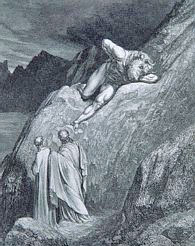
Engraving of the Minotaur, by Dore, 1861


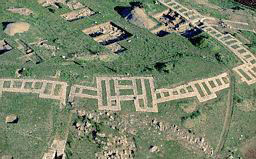
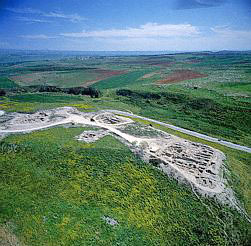
Areal view of Hittite Ruins


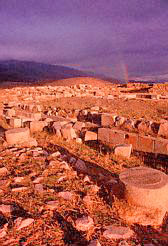
Uraratian Site in Altintepe, Turkey. They were a people related to the Hurrians and Hittites and contemporaries of the Assyrians

"Over the years, startling evidence has been unearthed...."

Sumerian Father of the Gods....
Another Symbol "the Winged Star"
EL, the "lofty deity"....

"In the thirteenth century B.C., under the presence of vast migrations and invasions (including the Israelite thrust from Egypt to Canaan), the Hurrians retreated to the northeastern portion of their kingdom. Establishing their new capital near Lake Van, they called their kingdom Urarty ("Ararat"). There they worshiped a pantheon headed by Tesheba (Teshub), depicting him as a vigorous god wearing a horned cap and standing upon his cult symbol, the bull. They called their main shrine Bitanu ("house of Anu") and dedicated themselves to making their kingdom "the fortress of the valley of Anu, as we shall see, was the Sumerian Father of the Gods.

"......The lands that are today IsraelLebanon, and southern Syria -which formed the southwestern band of the ancient Fertile Crescent -were then the habitat of peoples that can be grouped together as the Canaanites.

".....The pantheon that unfolds from the Canaanite texts bears many similarities to the later Greek one. At the head of the Canaanite pantheon, too, there was a supreme deity called EL, a word that was the personal name of the god and the generic term meaning "lofty deity."

"A stela found in Palestine depicts an elderly deity sitting on a throne and being served a beverage by a younger deity. The seated deity wears a conical headdress adorned with horns - a mark of the gods, as we have seen, from prehistoric times - and the scene is dominated by the Symbol of a Winged Star - the ubiquitous emblem that we shall increasingly encounter. It is generally accepted by the scholars that this sculptured relief depicts EL, the senior Canaanite deity.

The Winged Star, is a circle in which an eight point star is enclosed and wings sprang opened from the circle’s each side.

"Whence had the Canaanites, for their part, drawn their culture and religion?

"The Egyptians believed in Gods of Heaven and Earth. Great Gods that were clearly distinguished from the multitudes of lesser deities. G.A. Wainwright (The Sky Religion in Egypt) summed up the evidence, showing that the Egyptian belief in Gods of Heaven who descended to Earth from the skies was "extremely ancient." Some of the epithets of these Great Gods - Greatest God-Bull of Heaven, Lord/Lady of the Mountains - sound familiar.

"Although the Egyptians counted by the decimal system, their religious affairs were governed by the Sumerian sexagesimal sixty, and celestial matters were subjected to the divine number twelve. The heavens were divided into three parts, each comprising twelve celestial bodies. The afterworld was divided into twelve parts. Day and night were each divided into twelve hours. And all these divisions were paralleled by "companies" of gods, which in turn consisted of - twelve gods each.

"The head of the Egyptian pantheon was Ra ("creator") who presided over an Assembly of the Gods that numbered twelve.

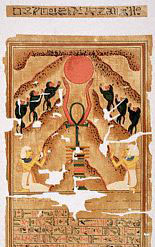
"......Ra was an unseen celestial god who manifested himself only periodically. His manifestation was the ATEN - the Celestial Disc, depicted as a Winged Globe.

Symbol.- The ATEN was a blank circle with wings spanning from each side. Ra had two sons, Osiris and SethHorus, son of Osiris is represented sometimes as a winged and horned deity. Obviously as representation of the Kingdom from Ra.

"The earlier notion that civilization may have begun in Egypt has been discarded by now. There is ample evidence now showing that the Egyptian - organized society and civilization, which began half a millennium and more after the Sumerian one, drew its culture, architecture, technology, art of writing, and many other aspects of a high civilization from Sumer. The weight of evidence also shows that the gods of Egypt originated in Sumer.

The Canaanites could not boast of an original pantheon. They, too, acquired their cosmogony, deities, and legendary tales from elsewhere. Their direct contacts with the Sumerian sources were the Amorites.

"In the 1980’s archaeologists came upon the center and capital city of the Amorites, known as Mari. At a bend of the Euphrates, where the Syrian border now cuts the river, the diggers uncovered a major city whose buildings were erected and continuously re-erected, between 3000 and 2000 B.C., on foundations that date to centuries earlier. These earlier remains included a step pyramid and temples to the Sumerian deities InannaNinhursag, and Enlil.

"Who were these Gods of Heaven and Earthdivine yet human, always headed by a pantheon of inner circle and twelve deities?


We have entered the temples of the Greeks, and the Aryans, the Hittites and the Hurrians, the Canaanites, the Egyptians, and the Amorites. We have followed paths that took us across continents and seas, and clues that carried us over several millennia. And all the corridors of all the temples have led us to one source: Sumer.

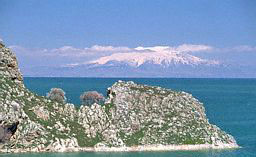
Lake Van and Akdamar Island,
Turkey

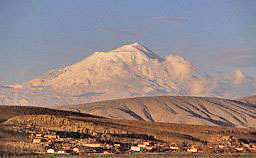
Mount Ararat and Village of Dogubayazit,Turkey

.

TEL HAZOR AND GREEN FIELDS

Has revealed 21 levels of occupation. During the time of the Pre-Israelites it was the leading city of many kingdoms. An important city along the Via Maris, trade route between Egypt and the FERTILE CRESCENT. Israel.

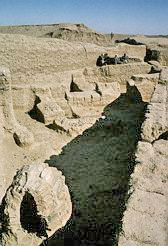
Excavated Ruins at Mari

Adoration of Ra


Chapter Four
SUMER: LAND OF THE GODS


Anu, Head of the Family of Gods.... His Symbol

The head of this family of Gods of Heaven and Earth was AN (or Anu in the Babylonian/Assyrian texts). He was the Great Father of the Gods, The King of the Gods. His realm was the expanse of the heavens, and his symbol was a star. In the Sumerian pictographic writing, the sign of a star also stood for An, for "heavens" and for "divine being," or "god" (descended of An). This fourfold of the symbol remained through the ages, as the script moved from the Sumerian pictographic to the cuneiform Akkadian, to the stylized Babylonian and Assyrian."

Symbol.- The star was an eight point star for "An = star."

An eight point star was also for "heaven", but with four of its arms (from top) to its left like a sector shape (fan).

A cross with a small inverted triangle on the top arm and with two small triangles (one above the other) to its left arm, was for "god."

"The Sumerian claim that not only gods but also selected mortals could ascend to the Divine Abode in the heavens is echoed in the Old Testament tales of the ascents to the heavens by Enoch and the prophet Elijah.

".....Anu had a spouse ANTU.

"A tablet that belonged to an archive at Uruk enlightens us to the pomp and pageantry that accompany the arrival of Anu and his spouse on a "state visit." Because of damage to a tablet, we can read of the ceremonies only from some midpoint, when Anu and Antu were already seated in the temple’s courtyard. The gods, "exactly in the same order as before" then formed a procession ahead of and behind the bearer of the scepter. The protocol then instructed:

They shall then descend to the Exalted Court,
and shall turn towards the god Anu.
The Priest of Purification shall libate the Scepter,
and the Scepter-bearer shall enter and be seated.
The deities Papsukal, Nusku and Shala
shall then be seated in the court of the god Anu.

Many activities would follow.

"While an "evening meal"- various drinks and appetizers - were being served, an astronomer-priest went up to the "topmost stage of the tower of the main temple" to observe the skies. He was to look out for the rising in a specific part of the sky of the planet named Great Anu of Heaven. Thereupon, he was to recite the compositions named: "To the one who grows bright, the heavenly planet of the Lord Anu" and "The Creator’s image has risen."

Among other activities of preparation:

"Meanwhile the whole country was to light up and celebrate the presence of the two divine visitors. On a signal from the main temple, the priests from all the other temples of Uruk were "to use torches to start bonfires"; and the priests in other cities, seeing the bonfires at Uruk, were to do likewise.

"Then:

The people of the Land will light fires in their homes,
and shall offer banquets to all the gods ....
The guards of the cities shall light fires
in the streets and in the squares."

"The departure of the two Great Gods was also planned, not only to the day but to the minute.

On the seventeenth day,
forty minutes after sunrise,
the gate shall be opened before the gods Anu and Antu,
bringing to an end their overnight stay.

"By Sumerian tradition, rulership flowed from Anu; and the very term for "Kingship" was Anutu (Anu-ship). The insignia of Anu were the tiaria (the divine headdress), the scepter (symbol of power), and the staff (symbolizing the guidance provided by the shepherd). The shepherd’s staff may now be found more in the hands of bishops than of kings. But the crown and scepter are still held by whatever kings Mankind has left on some thrones.

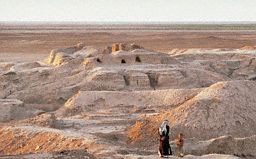
Ruins of the ancient Sumerian city of Uruk, Iraq

next

Saturday, May 13, 2017

THE URANTIA PAPERS # 65 OVER-CONTROL OF EVOLUTION,# 66 THE PLANETARY PRINCE OF URANTIA, # 67 THE PLANETARY REBELLION

THE URANTIA PAPERS # 65 OVER-CONTROL OF EVOLUTION,# 66 THE PLANETARY PRINCE OF URANTIA, # 67 THE PLANETARY REBELLION

These are 3 of the more interesting Papers,with regard to the stuff of legends and misguided stories about so called winged creatures right up to this very day.A couple of thoughts on these 3 Papers and the ones going forward.I have refrained from commenting very much on the ones I have presented so far to make sure it is clear that I do not try and influence what anyone reading these might think. With that said,on Paper 66 or 67, I did make one short comment which is my opinion on a certain verse from the scriptures of tradition, I do not claim it as fact. Also underneath a Pic of the Persian Gulf, I have linked the page where a gentleman says he believes he has found the Princes city  of Dalamatia under the waters of the gulf. This Paper on the Planetary Rebellion, is from the perspective of those Beings who were on the planet when Caligastia betrayed his charge and threw his hat in with the misguided Lanonandek Son Lucifer in his challenge of Michael's sovereignty and the invisible Father.These 3 Papers are from Part 3 dealing with the history of the Planet. The next Papers will be back from Part 2 and they will cover The Rebellion from the Universe and Lucifer's Superiors perspective. Take care all  


Paper 65

The Over-control of Evolution

Image result for IMAGES OF THE PARADISE TRINITY
65:0.1 (730.1) BASIC evolutionary material life — premind life — is the formulation of the Master Physical Controllers and the life-impartation ministry of the Seven Master Spirits in conjunction with the active ministration of the ordained Life Carriers. As a result of the co-ordinate function of this threefold creativity there develops organismal physical capacity for mind — material mechanisms for intelligent reaction to external environmental stimuli and, later on, to internal stimuli, influences taking origin in the organismal mind itself.
65:0.2 (730.2) There are, then, three distinct levels of life production and evolution:
65:0.3 (730.3) 1. The physical-energy domain — mind-capacity production.
65:0.4 (730.4) 2. The mind ministry of the adjutant spirits — impinging upon spirit capacity.
65:0.5 (730.5) 3. The spirit endowment of mortal mind — culminating in Thought Adjuster bestowal.
65:0.6 (730.6) The mechanical-non-teachable levels of organismal environmental response are the domains of the physical controllers. The adjutant mind-spirits activate and regulate the adaptive or non-mechanical-teachable types of mind — those response mechanisms of organisms capable of learning from experience. And as the spirit adjutants thus manipulate mind potentials, so do the Life Carriers exercise considerable discretionary control over the environmental aspects of evolutionary processes right up to the time of the appearance of human will — the ability to know God and the power of choosing to worship him.
65:0.7 (730.7) It is the integrated functioning of the Life Carriers, the physical controllers, and the spirit adjutants that conditions the course of organic evolution on the inhabited worlds. And this is why evolution — on Urantia or elsewhere — is always purposeful and never accidental.

Life Carrier Functions

65:1.1 (730.8) The Life Carriers are endowed with potentials of personality metamorphosis which but few orders of creatures possess. These Sons of the local universe are capable of functioning in three diverse phases of being. They ordinarily perform their duties as mid-phase Sons, that being the state of their origin. But a Life Carrier in such a stage of existence could not possibly function in the electro-chemical domains as a fabricator of physical energies and material particles into units of living existence.
65:1.2 (730.9) Life Carriers are able to function and do function on the following three levels:
65:1.3 (730.10) 1. The physical level of electrochemistry.
65:1.4 (730.11) 2. The usual mid-phase of quasi-morontial existence.
65:1.5 (730.12) 3. The advanced semispiritual level.
65:1.6 (731.1) When the Life Carriers make ready to engage in life implantation, and after they have selected the sites for such an undertaking, they summon the archangel commission of Life Carrier transmutation. This group consists of ten orders of diverse personalities, including the physical controllers and their associates, and is presided over by the chief of archangels, who acts in this capacity by the mandate of Gabriel and with the permission of the Ancients of Days. When these beings are properly encircuited, they can effect such modifications in the Life Carriers as will enable them immediately to function on the physical levels of electrochemistry.
65:1.7 (731.2) After the life patterns have been formulated and the material organizations have been duly completed, the supermaterial forces concerned in life propagation become forthwith active, and life is existent. Whereupon the Life Carriers are immediately returned to their normal mid-phase of personality existence, in which estate they can manipulate the living units and maneuver the evolving organisms, even though they are shorn of all ability to organize — create — new patterns of living matter.
65:1.8 (731.3) After organic evolution has run a certain course and free will of the human type has appeared in the highest evolving organism02's, the Life Carriers must either leave the planet or take renunciation vows; that is, they must pledge themselves to refrain from all attempts further to influence the course of organic evolution. And when such vows are voluntarily taken by those Life Carriers who choose to remain on the planet as future advisers to those who shall be entrusted with the fostering of the newly evolved will creatures, there is summoned a commission of twelve, presided over by the chief of the Evening Stars, acting by authority of the System Sovereign and with permission of Gabriel; and forthwith these Life Carriers are transmuted to the third phase of personality existence — the semi-spiritual level of being. And I have functioned on Urantia in this third phase of existence ever since the times of Andon and Fonta.
65:1.9 (731.4) We look forward to a time when the universe may be settled in light and life, to a possible fourth stage of being wherein we shall be wholly spiritual, but it has never been revealed to us by what technique we may attain this desirable and advanced estate.

2

The Evolutionary Panorama

65:2.1 (731.5) The story of man’s ascent from seaweed to the lordship of earthly creation is indeed a romance of biologic struggle and mind survival. Man’s primordial ancestors were literally the slime and ooze of the ocean bed in the sluggish and warm-water bays and lagoons of the vast shore lines of the ancient inland seas, those very waters in which the Life Carriers established the three independent life implantations on Urantia.
65:2.2 (731.6) Very few species of the early types of marine vegetation that participated in those epochal changes which resulted in the animal like borderland organisms are in existence today. The sponges are the survivors of one of these early midway types, those organisms through which the gradual transition from the vegetable to the animal took place. These early transition forms, while not identical with modern sponges, were much like them; they were true borderline organisms — neither vegetable nor animal — but they eventually led to the development of the true animal forms of life.
65:2.3 (732.1) The bacteria, simple vegetable organisms of a very primitive nature, are very little changed from the early dawn of life; they even exhibit a degree of retrogression in their parasitic behavior. Many of the fungi also represent a retrograde movement in evolution, being plants which have lost their chlorophyll-making ability and have become more or less parasitic. The majority of disease-causing bacteria and their auxiliary virus bodies really belong to this group of renegade parasitic fungi. During the intervening ages all of the vast kingdom of plant life has evolved from ancestors from which the bacteria have also descended.
65:2.4 (732.2) The higher protozoan type of animal life soon appeared, and appeared suddenly. And from these far-distant times the amoeba, the typical single-celled animal organism, has come on down but little modified. He disports himself today much as he did when he was the last and greatest achievement in life evolution. This minute creature and his protozoan cousins are to the animal creation what bacteria are to the plant kingdom; they represent the survival of the first early evolutionary steps in life differentiation together with failure of subsequent development. 
65:2.5 (732.3) Before long the early single-celled animal types associated themselves in communities, first on the plan of the Volvox and presently along the lines of the Hydra and jellyfish. Still later there evolved the starfish, stone lilies, sea urchins, sea cucumbers, centipedes, insects, spiders, crustaceans, and the closely related groups of earthworms and leeches, soon followed by the mollusks — the oyster, octopus, and snail. Hundreds upon hundreds of species intervened and perished; mention is made only of those which survived the long, long struggle. Such non-progressive specimens, together with the later appearing fish family, today represent the stationary types of early and lower animals, branches of the tree of life which failed to progress.
65:2.6 (732.4) The stage was thus set for the appearance of the first backboned animals, the fishes. From this fish family there sprang two unique modifications, the frog and the salamander. And it was the frog which began that series of progressive differentiations in animal life that finally culminated in man himself.
65:2.7 (732.5) The frog is one of the earliest of surviving human-race ancestors, but it also failed to progress, persisting today much as in those remote times. The frog is the only species ancestor of the early dawn races now living on the face of the earth. The human race has no surviving ancestry between the frog and the Eskimo.
65:2.8 (732.6) The frogs gave rise to the Reptilia, a great animal family which is virtually extinct, but which, before passing out of existence, gave origin to the whole bird family and the numerous orders of mammals.
65:2.9 (732.7) Probably the greatest single leap of all prehuman evolution was executed when the reptile became a bird. The bird types of today — eagles, ducks, pigeons, and ostriches — all descended from the enormous reptiles of long, long ago.
65:2.10 (732.8) The kingdom of reptiles, descended from the frog family, is today represented by four surviving divisions: two nonprogressive, snakes and lizards, together with their cousins, alligators and turtles; one partially progressive, the bird family, and the fourth, the ancestors of mammals and the direct line of descent of the human species. But though long departed, the massiveness of the passing Reptilia found echo in the elephant and mastodon, while their peculiar forms were perpetuated in the leaping kangaroos.
65:2.11 (733.1) Only fourteen phyla have appeared on Urantia, the fishes being the last, and no new classes have developed since birds and mammals.
65:2.12 (733.2) It was from an agile little reptilian dinosaur of carnivorous habits but having a comparatively large brain that the placental mammals suddenly sprang. These mammals developed rapidly and in many different ways, not only giving rise to the common modern varieties but also evolving into marine types, such as whales and seals, and into air navigators like the bat family.
65:2.13 (733.3) Man thus evolved from the higher mammals derived principally from the western implantation of life in the ancient east-west sheltered seas. The eastern and central groups of living organisms were early progressing favorably toward the attainment of prehuman levels of animal existence. But as the ages passed, the eastern focus of life emplacement failed to attain a satisfactory level of intelligent prehuman status, having suffered such repeated and irretrievable losses of its highest types of germ plasm that it was forever shorn of the power to rehabilitate human potentialities.
65:2.14 (733.4) Since the quality of the mind capacity for development in this eastern group was so definitely inferior to that of the other two groups, the Life Carriers, with the consent of their superiors, so manipulated the environment as further to circumscribe these inferior prehuman strains of evolving life. To all outward appearances the elimination of these inferior groups of creatures was accidental, but in reality it was altogether purposeful.
65:2.15 (733.5) Later in the evolutionary unfolding of intelligence, the lemur ancestors of the human species were far more advanced in North America than in other regions; and they were therefore led to migrate from the arena of western life implantation over the Bering land bridge and down the coast to southwestern Asia, where they continued to evolve and to benefit by the addition of certain strains of the central life group. Man thus evolved out of certain western and central life strains but in the central to near-eastern regions.
65:2.16 (733.6) In this way the life that was planted on Urantia evolved until the ice age, when man himself first appeared and began his eventful planetary career. And this appearance of primitive man on earth during the ice age was not just an accident; it was by design. The rigors and climatic severity of the glacial era were in every way adapted to the purpose of fostering the production of a hardy type of human being with tremendous survival endowment.

The Fostering of Evolution

Image result for hubble telescope images
65:3.1 (733.7) It will hardly be possible to explain to the present-day human mind many of the queer and apparently grotesque occurrences of early evolutionary progress. A purposeful plan was functioning throughout all of these seemingly strange evolution's of living things, but we are not allowed arbitrarily to interfere with the development of the life patterns after they have once been set in operation.
65:3.2 (733.8) Life Carriers may employ every possible natural resource and may utilize any and all fortuitous circumstances which will enhance the developmental progress of the life experiment, but we are not permitted mechanically to intervene in, or arbitrarily to manipulate the conduct and course of, either plant or animal evolution.
65:3.3 (733.9) You have been informed that Urantia mortals evolved by way of primitive frog development, and that this ascending strain, carried in potential in a single frog, narrowly escaped extinction on a certain occasion. But it should not be inferred that the evolution of mankind would have been terminated by an accident at this juncture. At that very moment we were observing and fostering no less than one thousand different and remotely situated mutating strains of life which could have been directed into various different patterns of prehuman development. This particular ancestral frog represented our third selection, the two prior life strains having perished in spite of all our efforts toward their conservation.
65:3.4 (734.1) Even the loss of Andon and Fonta before they had offspring, though delaying human evolution, would not have prevented it. Subsequent to the appearance of Andon and Fonta and before the mutating human potentials of animal life were exhausted, there evolved no less than seven thousand favorable strains which could have achieved some sort of human type of development. And many of these better stocks were subsequently assimilated by the various branches of the expanding human species.
65:3.5 (734.2) Long before the Material Son and Daughter, the biologic up-lifters, arrive on a planet, the human potentials of the evolving animal species have been exhausted. This biologic status of animal life is disclosed to the Life Carriers by the phenomenon of the third phase of adjutant spirit mobilization, which automatically occurs concomitantly with the exhaustion of the capacity of all animal life to give origin to the mutant potentials of prehuman individuals.
65:3.6 (734.3) Mankind on Urantia must solve its problems of mortal development with the human stocks it has — no more races will evolve from prehuman sources throughout all future time. But this fact does not preclude the possibility of the attainment of vastly higher levels of human development through the intelligent fostering of the evolutionary potentials still resident in the mortal races. That which we, the Life Carriers, do toward fostering and conserving the life strains before the appearance of human will, man must do for himself after such an event and subsequent to our retirement from active participation in evolution. In a general way, man’s evolutionary destiny is in his own hands, and scientific intelligence must sooner or later supersede the random functioning of uncontrolled natural selection and chance survival.
65:3.7 (734.4) And in discussing the fostering of evolution, it would not be amiss to point out that, in the long future ahead, when you may sometime be attached to a corps of Life Carriers, you will have abundant and ample opportunity to offer suggestions and make any possible improvements in the plans and technique of life management and transplantation. Be patient! If you have good ideas, if your minds are fertile with better methods of administration for any part of the universal domains, you are certainly going to have an opportunity to present them to your associates and fellow administrators in the ages to come.

The Urantia Adventure

65:4.1 (734.5) Do not overlook the fact that Urantia was assigned to us as a life-experiment world. On this planet we made our sixtieth attempt to modify and, if possible, improve the Satania adaptation of the Nebadon life designs, and it is of record that we achieved numerous beneficial modifications of the standard life patterns. To be specific, on Urantia we worked out and have satisfactorily demonstrated not less than twenty-eight features of life modification which will be of service to all Nebadon throughout all future time.
65:4.2 (735.1) But the establishment of life on no world is ever experimental in the sense that something untried and unknown is attempted. The evolution of life is a technique ever progressive, differential, and variable, but never haphazard, uncontrolled, nor wholly experimental, in the accidental sense.
65:4.3 (735.2) Many features of human life afford abundant evidence that the phenomenon of mortal existence was intelligently planned, that organic evolution is not a mere cosmic accident. When a living cell is injured, it possesses the ability to elaborate certain chemical substances which are empowered so to stimulate and activate the neighboring normal cells that they immediately begin the secretion of certain substances which facilitate healing processes in the wound; and at the same time these normal and uninjured cells begin to proliferate — they actually start to work creating new cells to replace any fellow cells which may have been destroyed by the accident.
65:4.4 (735.3) This chemical action and reaction concerned in wound healing and cell reproduction represents the choice of the Life Carriers of a formula embracing over one hundred thousand phases and features of possible chemical reactions and biologic repercussions. More than half a million specific experiments were made by the Life Carriers in their laboratories before they finally settled upon this formula for the Urantia life experiment.
65:4.5 (735.4) When Urantia scientists know more of these healing chemicals, they will become more efficient in the treatment of injuries, and indirectly they will know more about controlling certain serious diseases.
65:4.6 (735.5) Since life was established on Urantia, the Life Carriers have improved this healing technique as it has been introduced on another Satania world, in that it affords more pain relief and exercises better control over the proliferation capacity of the associated normal cells.
65:4.7 (735.6) There were many unique features of the Urantia life experiment, but the two outstanding episodes were the appearance of the Andonic race prior to the evolution of the six colored peoples and the later simultaneous appearance of the Sangik mutants in a single family. Urantia is the first world in Satania where the six colored races sprang from the same human family. They ordinarily arise in diversified strains from independent mutations within the prehuman animal stock and usually appear on earth one at a time and successively over long periods of time, beginning with the red man and passing on down through the colors to indigo.
65:4.8 (735.7) Another outstanding variation of procedure was the late arrival of the Planetary Prince. As a rule, the prince appears on a planet about the time of will development; and if such a plan had been followed, Caligastia might have come to Urantia even during the lifetimes of Andon and Fonta instead of almost five hundred thousand years later, simultaneously with the appearance of the six Sangik races.
65:4.9 (735.8) On an ordinary inhabited world a Planetary Prince would have been granted on the request of the Life Carriers at, or sometime after, the appearance of Andon and Fonta. But Urantia having been designated a life-modification planet, it was by preagreement that the Melchizedek observers, twelve in number, were sent as advisers to the Life Carriers and as overseers of the planet until the subsequent arrival of the Planetary Prince. These Melchizedeks came at the time Andon and Fonta made the decisions which enabled Thought Adjusters to indwell their mortal minds.
65:4.10 (736.1) On Urantia the endeavors of the Life Carriers to improve the Satania life patterns necessarily resulted in the production of many apparently useless forms of transition life. But the gains already accrued are sufficient to justify the Urantia modifications of the standard life designs.
65:4.11 (736.2) It was our intention to produce an early manifestation of will in the evolutionary life of Urantia, and we succeeded. Ordinarily, will does not emerge until the colored races have long been in existence, usually first appearing among the superior types of the red man. Your world is the only planet in Satania where the human type of will has appeared in a precolored race.
65:4.12 (736.3) But in our effort to provide for that combination and association of inheritance factors which finally gave rise to the mammalian ancestors of the human race, we were confronted with the necessity of permitting hundreds and thousands of other and comparatively useless combinations and associations of inheritance factors to take place. Many of these seemingly strange by-products of our efforts are certain to meet your gaze as you dig back into the planetary past, and I can well understand how puzzling some of these things must be to the limited human viewpoint.

Life-Evolution Vicissitudes

Image result for images of evolution
65:5.1 (736.4) It was a source of regret to the Life Carriers that our special efforts to modify intelligent life on Urantia should have been so handicapped by tragic perversions beyond our control: the Caligastia betrayal and the Adamic default.
65:5.2 (736.5) But throughout all of this biologic adventure our greatest disappointment grew out of the reversion of certain primitive plant life to the prechlorophyll levels of parasitic bacteria on such an extensive and unexpected scale. This eventuality in plant-life evolution caused many distressful diseases in the higher mammals, particularly in the more vulnerable human species. When we were confronted with this perplexing situation, we somewhat discounted the difficulties involved because we knew that the subsequent admixture of the Adamic life plasm would so reinforce the resisting powers of the resulting blended race as to make it practically immune to all diseases produced by the vegetable type of organism. But our hopes were doomed to disappointment owing to the misfortune of the Adamic default.
65:5.3 (736.6) The universe of universes, including this small world called Urantia, is not being managed merely to meet our approval nor just to suit our convenience, much less to gratify our whims and satisfy our curiosity. The wise and all-powerful beings who are responsible for universe management undoubtedly know exactly what they are about; and so it becomes Life Carriers and behooves mortal minds to enlist in patient waiting and hearty co-operation with the rule of wisdom, the reign of power, and the march of progress.
65:5.4 (736.7) There are, of course, certain compensations for tribulation, such as Michael’s bestowal on Urantia. But irrespective of all such considerations, the later celestial supervisors of this planet express complete confidence in the ultimate evolutionary triumph of the human race and in the eventual vindication of our original plans and life patterns.

6

Evolutionary Techniques of Life

65:6.1 (737.1) It is impossible accurately to determine, simultaneously, the exact location and the velocity of a moving object; any attempt at measurement of either inevitably involves change in the other. The same sort of a paradox confronts mortal man when he undertakes the chemical analysis of protoplasm. The chemist can elucidate the chemistry of dead protoplasm, but he cannot discern either the physical organization or the dynamic performance of living protoplasm. Ever will the scientist come nearer and nearer the secrets of life, but never will he find them and for no other reason than that he must kill protoplasm in order to analyze it. Dead protoplasm weighs the same as living protoplasm, but it is not the same.
65:6.2 (737.2) There is original endowment of adaptation in living things and beings. In every living plant or animal cell, in every living organism — material or spiritual — there is an insatiable craving for the attainment of ever-increasing perfection of environmental adjustment, organismal adaptation, and augmented life realization. These interminable efforts of all living things evidence the existence within them of an innate striving for perfection.
65:6.3 (737.3) The most important step in plant evolution was the development of chlorophyll-making ability, and the second greatest advance was the evolution of the spore into the complex seed. The spore is most efficient as a reproductive agent, but it lacks the potentials of variety and versatility inherent in the seed.
65:6.4 (737.4) One of the most serviceable and complex episodes in the evolution of the higher types of animals consisted in the development of the ability of the iron in the circulating blood cells to perform in the double role of oxygen carrier and carbon dioxide remover. And this performance of the red blood cells illustrates how evolving organisms are able to adapt their functions to varying or changing environment. The higher animals, including man, oxygenate their tissues by the action of the iron of the red blood cells, which carries oxygen to the living cells and just as efficiently removes the carbon dioxide. But other metals can be made to serve the same purpose. The cuttlefish employs copper for this function, and the sea squirt utilizes vanadium.
65:6.5 (737.5) The continuation of such biologic adjustments is illustrated by the evolution of teeth in the higher Urantia mammals; these attained to thirty-six in man’s remote ancestors, and then began an adaptative readjustment toward thirty-two in the dawn man and his near relatives. Now the human species is slowly gravitating toward twenty-eight. The process of evolution is still actively and adaptatively in progress on this planet.
65:6.6 (737.6) But many seemingly mysterious adjustments of living organisms are purely chemical, wholly physical. At any moment of time, in the blood stream of any human being there exists the possibility of upward of 15,000,000 chemical reactions between the hormone output of a dozen ductless glands.
65:6.7 (737.7) The lower forms of plant life are wholly responsive to physical, chemical, and electrical environment. But as the scale of life ascends, one by one the mind ministries of the seven adjutant spirits become operative, and the mind becomes increasingly adjustive, creative, co-ordinative, and dominative. The ability of animals to adapt themselves to air, water, and land is not a supernatural endowment, but it is a superphysical adjustment.
65:6.8 (738.1) Physics and chemistry alone cannot explain how a human being evolved out of the primeval protoplasm of the early seas. The ability to learn, memory and differential response to environment, is the endowment of mind. The laws of physics are not responsive to training; they are immutable and unchanging. The reactions of chemistry are not modified by education; they are uniform and dependable. Aside from the presence of the Unqualified Absolute, electrical and chemical reactions are predictable. But mind can profit from experience, can learn from reactive habits of behavior in response to repetition of stimuli.
65:6.9 (738.2) Preintelligent organisms react to environmental stimuli, but those organisms which are reactive to mind ministry can adjust and manipulate the environment itself.
65:6.10 (738.3) The physical brain with its associated nervous system possesses innate capacity for response to mind ministry just as the developing mind of a personality possesses a certain innate capacity for spirit receptivity and therefore contains the potentials of spiritual progress and attainment. Intellectual, social, moral, and spiritual evolution are dependent on the mind ministry of the seven adjutant spirits and their superphysical associates.

Evolutionary Mind Levels

65:7.1 (738.4) The seven adjutant mind-spirits are the versatile mind ministers to the lower intelligent existences of a local universe. This order of mind is ministered from the local universe headquarters or from some world connected therewith, but there is influential direction of lower-mind function from the system capitals.
65:7.2 (738.5) On an evolutionary world much, very much, depends on the work of these seven adjutants. But they are mind ministers; they are not concerned in physical evolution, the domain of the Life Carriers. Nevertheless, the perfect integration of these spirit endowments with the ordained and natural procedure of the unfolding and inherent regime of the Life Carriers is responsible for the mortal inability to discern, in the phenomenon of mind, aught but the hand of nature and the outworking of natural processes, albeit you are occasionally somewhat perplexed in explaining all of everything connected with the natural reactions of mind as it is associated with matter. And if Urantia were operating more in accordance with the original plans, you would observe even less to arrest your attention in the phenomenon of mind.
65:7.3 (738.6) The seven adjutant spirits are more circuitlike than entitylike, and on ordinary worlds they are encircuited with other adjutant functionings throughout the local universe. On life-experiment planets, however, they are relatively isolated. And on Urantia, owing to the unique nature of the life patterns, the lower adjutants experienced far more difficulty in contacting with the evolutionary organisms than would have been the case in a more standardized type of life endowment.
65:7.4 (738.7) Again, on an average evolutionary world the seven adjutant spirits are far better synchronized with the advancing stages of animal development than they were on Urantia. With but a single exception, the adjutants experienced the greatest difficulty in contacting with the evolving minds of Urantia organisms that they had ever had in all their functioning throughout the universe of Nebadon. On this world there developed many forms of border phenomena — confusional combinations of the mechanical-nonteachable and the nonmechanical-teachable types of organismal response.
65:7.5 (739.1) The seven adjutant spirits do not make contact with the purely mechanical orders of organismal environmental response. Such preintelligent responses of living organisms pertain purely to the energy domains of the power centers, the physical controllers, and their associates.
65:7.6 (739.2) The acquisition of the potential of the ability to learn from experience marks the beginning of the functioning of the adjutant spirits, and they function from the lowliest minds of primitive and invisible existences up to the highest types in the evolutionary scale of human beings. They are the source and pattern for the otherwise more or less mysterious behavior and incompletely understood quick reactions of mind to the material environment. Long must these faithful and always dependable influences carry forward their preliminary ministry before the animal mind attains the human levels of spirit receptivity.
65:7.7 (739.3) The adjutants function exclusively in the evolution of experiencing mind up to the level of the sixth phase, the spirit of worship. At this level there occurs that inevitable overlapping of ministry — the phenomenon of the higher reaching down to co-ordinate with the lower in anticipation of subsequent attainment of advanced levels of development. And still additional spirit ministry accompanies the action of the seventh and last adjutant, the spirit of wisdom. Throughout the ministry of the spirit world the individual never experiences abrupt transitions of spirit co-operation; always are these changes gradual and reciprocal.
65:7.8 (739.4) Always should the domains of the physical (electrochemical) and the mental response to environmental stimuli be differentiated, and in turn must they all be recognized as phenomena apart from spiritual activities. The domains of physical, mental, and spiritual gravity are distinct realms of cosmic reality, notwithstanding their intimate interrelations.

Evolution in Time and Space

65:8.1 (739.5) Time and space are indissolubly linked; there is an innate association. The delays of time are inevitable in the presence of certain space conditions.
65:8.2 (739.6) If spending so much time in effecting the evolutionary changes of life development occasions perplexity, I would say that we cannot time the life processes to unfold any faster than the physical metamorphoses of a planet will permit. We must wait upon the natural, physical development of a planet; we have absolutely no control over geologic evolution. If the physical conditions would allow, we could arrange for the completed evolution of life in considerably less than one million years. But we are all under the jurisdiction of the Supreme Rulers of Paradise, and time is nonexistent on Paradise.
65:8.3 (739.7) The individual’s yardstick for time measurement is the length of his life. All creatures are thus time conditioned, and therefore do they regard evolution as being a long-drawn-out process. To those of us whose life span is not limited by a temporal existence, evolution does not seem to be such a protracted transaction. On Paradise, where time is nonexistent, these things are all present in the mind of Infinity and the acts of Eternity.
65:8.4 (739.8) As mind evolution is dependent on, and delayed by, the slow development of physical conditions, so is spiritual progress dependent on mental expansion and unfailingly delayed by intellectual retardation. But this does not mean that spiritual evolution is dependent on education, culture, or wisdom. The soul may evolve regardless of mental culture but not in the absence of mental capacity and desire — the choice of survival and the decision to achieve ever-increasing perfection — to do the will of the Father in heaven. Although survival may not depend on the possession of knowledge and wisdom, progression most certainly does.
65:8.5 (740.1) In the cosmic evolutionary laboratories mind is always dominant over matter, and spirit is ever correlated with mind. Failure of these diverse endowments to synchronize and co-ordinate may cause time delays, but if the individual really knows God and desires to find him and become like him, then survival is assured regardless of the handicaps of time. Physical status may handicap mind, and mental perversity may delay spiritual attainment, but none of these obstacles can defeat the whole-souled choice of will.
65:8.6 (740.2) When physical conditions are ripe, sudden mental evolution's may take place; when mind status is propitious, sudden spiritual transformations may occur; when spiritual values receive proper recognition, then cosmic meanings become discernible, and increasingly the personality is released from the handicaps of time and delivered from the limitations of space.
65:8.7 (740.3) [Sponsored by a Life Carrier of Nebadon resident on Urantia.]

Paper 66

The Planetary Prince of Urantia

66:0.1 (741.1) THE advent of a Lanonandek Son on an average world signifies that will, the ability to choose the path of eternal survival, has developed in the mind of primitive man. But on Urantia the Planetary Prince arrived almost half a million years after the appearance of human will.

66:0.2 (741.2) About five hundred thousand years ago and concurrent with the appearance of the six colored or Sangik races, Caligastia, the Planetary Prince, arrived on Urantia. There were almost one-half billion primitive human beings on earth at the time of the Prince’s arrival, and they were well scattered over Europe, Asia, and Africa. The Prince’s headquarters, established in Mesopotamia, was at about the center of world population.

Prince Caligastia

66:1.1 (741.3) Caligastia was a Lanonandek Son, number 9,344 of the secondary order. He was experienced in the administration of the affairs of the local universe in general and, during later ages, with the management of the local system of Satania in particular.
66:1.2 (741.4) Prior to the reign of Lucifer in Satania, Caligastia had been attached to the council of the Life Carrier advisers on Jerusem. Lucifer elevated Caligastia to a position on his personal staff, and he acceptably filled five successive assignments of honor and trust.
66:1.3 (741.5) Caligastia very early sought a commission as Planetary Prince, but repeatedly, when his request came up for approval in the constellation councils, it would fail to receive the assent of the Constellation Fathers. Caligastia seemed especially desirous of being sent as planetary ruler to a decimal or life-modification world. His petition had several times been disapproved before he was finally assigned to Urantia.
66:1.4 (741.6) Caligastia went forth from Jerusem to his trust of world dominion with an enviable record of loyalty and devotion to the welfare of the universe of his origin and sojourn, notwithstanding a certain characteristic restlessness coupled with a tendency to disagree with the established order in certain minor matters.
66:1.5 (741.7) I was present on Jerusem when the brilliant Caligastia departed from the system capital. No prince of the planets ever embarked upon a career of world rulership with a richer preparatory experience or with better prospects than did Caligastia on that eventful day one-half million years ago. One thing is certain: As I executed my assignment of putting the narrative of that event on the broadcasts of the local universe, I never for one moment entertained even in the slightest degree any idea that this noble Lanonandek would so shortly betray his sacred trust of planetary custody and so horribly stain the fair name of his exalted order of universe sonship. I really regarded Urantia as being among the five or six most fortunate planets in all Satania in that it was to have such an experienced, brilliant, and original mind at the helm of world affairs. I did not then comprehend that Caligastia was insidiously falling in love with himself; I did not then so fully understand the subtleties of personality pride.

2

The Prince’s Staff

66:2.1 (742.1) The Planetary Prince of Urantia was not sent out on his mission alone but was accompanied by the usual corps of assistants and administrative helpers.
66:2.2 (742.2) At the head of this group was Daligastia, the associate-assistant of the Planetary Prince. Daligastia was also a secondary Lanonandek Son, being number 319,407 of that order. He ranked as an assistant at the time of his assignment as Caligastia’s associate.
66:2.3 (742.3) The planetary staff included a large number of angelic co-operators and a host of other celestial beings assigned to advance the interests and promote the welfare of the human races. But from your standpoint the most interesting group of all were the corporeal members of the Prince’s staff — sometimes referred to as the Caligastia one hundred.
66:2.4 (742.4) These one hundred rematerialized members of the Prince’s staff were chosen by Caligastia from over 785,000 ascendant citizens of Jerusem who volunteered for embarkation on the Urantia adventure. Each one of the chosen one hundred was from a different planet, and none of them were from Urantia.
66:2.5 (742.5) These Jerusemite volunteers were brought by seraphic transport direct from the system capital to Urantia, and upon arrival they were held enseraphimed until they could be provided with personality forms of the dual nature of special planetary service, literal bodies consisting of flesh and blood but also attuned to the life circuits of the system.
66:2.6 (742.6) Sometime before the arrival of these one hundred Jerusem citizens, the two supervising Life Carriers resident on Urantia, having previously perfected their plans, petitioned Jerusem and Edentia for permission to transplant the life plasm of one hundred selected survivors of the Andon and Fonta stock into the material bodies to be projected for the corporeal members of the Prince’s staff. The request was granted on Jerusem and approved on Edentia.
66:2.7 (742.7) Accordingly, fifty males and fifty females of the Andon and Fonta posterity, representing the survival of the best strains of that unique race, were chosen by the Life Carriers. With one or two exceptions these Andonite contributors to the advancement of the race were strangers to one another. They were assembled from widely separated places by co-ordinated Thought Adjuster direction and seraphic guidance at the threshold of the planetary headquarters of the Prince. Here the one hundred human subjects were given into the hands of the highly skilled volunteer commission from Avalon, who directed the material extraction of a portion of the life plasm of these Andon descendants. This living material was then transferred to the material bodies constructed for the use of the one hundred Jerusemite members of the Prince’s staff. Meantime, these newly arrived citizens of the system capital were held in the sleep of seraphic transport.
66:2.8 (742.8) These transactions, together with the literal creation of special bodies for the Caligastia one hundred, gave origin to numerous legends, many of which subsequently became confused with the later traditions concerning the planetary installation of Adam and Eve.
66:2.9 (743.1) The entire transaction of repersonalization, from the time of the arrival of the seraphic transports bearing the one hundred Jerusem volunteers until they became conscious, threefold beings of the realm, consumed exactly ten days.

3

Dalamatia — The City of the Prince

66:3.1 (743.2) The headquarters of the Planetary Prince was situated in the Persian Gulf region of those days, in the district corresponding to later Mesopotamia.
66:3.2 (743.3) The climate and landscape in the Mesopotamia of those times were in every way favorable to the undertakings of the Prince’s staff and their assistants, very different from conditions which have sometimes since prevailed. It was necessary to have such a favoring climate as a part of the natural environment designed to induce primitive Urantians to make certain initial advances in culture and civilization. The one great task of those ages was to transform man from a hunter to a herder, with the hope that later on he would evolve into a peace-loving, home-abiding farmer.
66:3.3 (743.4) The headquarters of the Planetary Prince on Urantia was typical of such stations on a young and developing sphere. The nucleus of the Prince’s settlement was a very simple but beautiful city, enclosed within a wall forty feet high. This world center of culture was named Dalamatia in honor of Daligastia.
66:3.4 (743.5) The city was laid out in ten subdivisions with the headquarters mansions of the ten councils of the corporeal staff situated at the centers of these subdivisions. Centermost in the city was the temple of the unseen Father. The administrative headquarters of the Prince and his associates was arranged in twelve chambers immediately grouped about the temple itself.
66:3.5 (743.6) The buildings of Dalamatia were all one story except the council headquarters, which were two stories, and the central temple of the Father of all, which was small but three stories in height.
66:3.6 (743.7) The city represented the best practices of those early days in building material — brick. Very little stone or wood was used. Home building and village architecture among the surrounding peoples were greatly improved by the Dalamatian example.
66:3.7 (743.8) Near the Prince’s headquarters there dwelt all colors and strata of human beings. And it was from these near-by tribes that the first students of the Prince’s schools were recruited. Although these early schools of Dalamatia were crude, they provided all that could be done for the men and women of that primitive age.
66:3.8 (743.9) The Prince’s corporeal staff continuously gathered about them the superior individuals of the surrounding tribes and, after training and inspiring these students, sent them back as teachers and leaders of their respective peoples.

Early Days of the One Hundred

66:4.1 (743.10) The arrival of the Prince’s staff created a profound impression. While it required almost a thousand years for the news to spread abroad, those tribes near the Mesopotamian headquarters were tremendously influenced by the teachings and conduct of the one hundred new sojourners on Urantia. And much of your subsequent mythology grew out of the garbled legends of these early days when these members of the Prince’s staff were repersonalized on Urantia as supermen.
66:4.2 (744.1) The serious obstacle to the good influence of such extraplanetary teachers is the tendency of mortals to regard them as gods, but aside from the technique of their appearance on earth the Caligastia one hundred — fifty men and fifty women — did not resort to supernatural methods nor superhuman manipulations.
66:4.3 (744.2) But the corporeal staff were nonetheless superhuman. They began their mission on Urantia as extraordinary threefold beings:
66:4.4 (744.3) 1. They were corporeal and relatively human, for they embodied the actual life plasm of one of the human races, the Andonic life plasm of Urantia.
66:4.5 (744.4) These one hundred members of the Prince’s staff were divided equally as to sex and in accordance with their previous mortal status. Each person of this group was capable of becoming coparental to some new order of physical being, but they had been carefully instructed to resort to parenthood only under certain conditions. It is customary for the corporeal staff of a Planetary Prince to procreate their successors sometime prior to retiring from special planetary service. Usually this is at, or shortly after, the time of the arrival of the Planetary Adam and Eve.
66:4.6 (744.5) These special beings therefore had little or no idea as to what type of material creature would be produced by their sexual union. And they never did know; before the time for such a step in the prosecution of their world work the entire regime was upset by rebellion, and those who later functioned in the parental role had been isolated from the life currents of the system.
66:4.7 (744.6) In skin color and language these materialized members of Caligastia’s staff followed the Andonic race. They partook of food as did the mortals of the realm with this difference: The re-created bodies of this group were fully satisfied by a nonflesh diet. This was one of the considerations which determined their residence in a warm region abounding in fruits and nuts. The practice of subsisting on a nonflesh diet dates from the times of the Caligastia one hundred, for this custom spread near and far to affect the eating habits of many surrounding tribes, groups of origin in the once exclusively meat-eating evolutionary races.
66:4.8 (744.7) 2. The one hundred were material but superhuman beings, having been reconstituted on Urantia as unique men and women of a high and special order.
66:4.9 (744.8) This group, while enjoying provisional citizenship on Jerusem, were as yet unfused with their Thought Adjusters; and when they volunteered and were accepted for planetary service in liaison with the descending orders of sonship, their Adjusters were detached. But these Jerusemites were superhuman beings — they possessed souls of ascendant growth. During the mortal life in the flesh the soul is of embryonic estate; it is born (resurrected) in the morontia life and experiences growth through the successive morontia worlds. And the souls of the Caligastia one hundred had thus expanded through the progressive experiences of the seven mansion worlds to citizenship status on Jerusem.
66:4.10 (744.9) In conformity to their instructions the staff did not engage in sexual reproduction, but they did painstakingly study their personal constitutions, and they carefully explored every imaginable phase of intellectual (mind) and morontia (soul) liaison. And it was during the thirty-third year of their sojourn in Dalamatia, long before the wall was completed, that number two and number seven of the Danite group accidentally discovered a phenomenon attendant upon the liaison of their morontia selves (supposedly nonsexual and nonmaterial); and the result of this adventure proved to be the first of the primary midway creatures. This new being was wholly visible to the planetary staff and to their celestial associates but was not visible to the men and women of the various human tribes. Upon authority of the Planetary Prince the entire corporeal staff undertook the production of similar beings, and all were successful, following the instructions of the pioneer Danite pair. Thus did the Prince’s staff eventually bring into being the original corps of 50,000 primary midwayers.
66:4.11 (745.1) These mid-type creatures were of great service in carrying on the affairs of the world’s headquarters. They were invisible to human beings, but the primitive sojourners at Dalamatia were taught about these unseen semispirits, and for ages they constituted the sum total of the spirit world to these evolving mortals.
66:4.12 (745.2) 3. The Caligastia one hundred were personally immortal, or undying. There circulated through their material forms the antidotal complements of the life currents of the system; and had they not lost contact with the life circuits through rebellion, they would have lived on indefinitely until the arrival of a subsequent Son of God, or until their sometime later release to resume the interrupted journey to Havona and Paradise.
66:4.13 (745.3) These antidotal complements of the Satania life currents were derived from the fruit of the tree of life, a shrub of Edentia which was sent to Urantia by the Most Highs of Norlatiadek at the time of Caligastia’s arrival. In the days of Dalamatia this tree grew in the central courtyard of the temple of the unseen Father, and it was the fruit of the tree of life that enabled the material and otherwise mortal beings of the Prince’s staff to live on indefinitely as long as they had access to it.
66:4.14 (745.4) While of no value to the evolutionary races, this supersustenance was quite sufficient to confer continuous life upon the Caligastia one hundred and also upon the one hundred modified Andonites who were associated with them.
66:4.15 (745.5) It should be explained in this connection that, at the time the one hundred Andonites contributed their human germ plasm to the members of the Prince’s staff, the Life Carriers introduced into their mortal bodies the complement of the system circuits; and thus were they enabled to live on concurrently with the staff, century after century, in defiance of physical death.
66:4.16 (745.6) Eventually the one hundred Andonites were made aware of their contribution to the new forms of their superiors, and these same one hundred children of the Andon tribes were kept at headquarters as the personal attendants of the Prince’s corporeal staff.

5

Organization of the One Hundred

66:5.1 (745.7) The one hundred were organized for service in ten autonomous councils of ten members each. When two or more of these ten councils met in joint session, such liaison gatherings were presided over by Daligastia. These ten groups were constituted as follows:
66:5.2 (745.8) 1. The council on food and material welfare. This group was presided over by Ang. Food, water, clothes, and the material advancement of the human species were fostered by this able corps. They taught well digging, spring control, and irrigation. They taught those from the higher altitudes and from the north improved methods of treating skins for use as clothing, and weaving was later introduced by the teachers of art and science.
66:5.3 (746.1) Great advances were made in methods of food storage. Food was preserved by cooking, drying, and smoking; it thus became the earliest property. Man was taught to provide for the hazards of famine, which periodically decimated the world.
66:5.4 (746.2) 2. The board of animal domestication and utilization. This council was dedicated to the task of selecting and breeding those animals best adapted to help human beings in bearing burdens and transporting themselves, to supply food, and later on to be of service in the cultivation of the soil. This able corps was directed by Bon.
66:5.5 (746.3) Several types of useful animals, now extinct, were tamed, together with some that have continued as domesticated animals to the present day. Man had long lived with the dog, and the blue man had already been successful in taming the elephant. The cow was so improved by careful breeding as to become a valuable source of food; butter and cheese became common articles of human diet. Men were taught to use oxen for burden bearing, but the horse was not domesticated until a later date. The members of this corps first taught men to use the wheel for the facilitation of traction.
66:5.6 (746.4) It was in these days that carrier pigeons were first used, being taken on long journeys for the purpose of sending messages or calls for help. Bon’s group were successful in training the great fandors as passenger birds, but they became extinct more than thirty thousand years ago.
66:5.7 (746.5) 3. The advisers regarding the conquest of predatory animals. It was not enough that early man should try to domesticate certain animals, but he must also learn how to protect himself from destruction by the remainder of the hostile animal world. This group was captained by Dan.
66:5.8 (746.6) The purpose of an ancient city wall was to protect against ferocious beasts as well as to prevent surprise attacks by hostile humans. Those living without the walls and in the forest were dependent on tree dwellings, stone huts, and the maintenance of night fires. It was therefore very natural that these teachers should devote much time to instructing their pupils in the improvement of human dwellings. By employing improved techniques and by the use of traps, great progress was made in animal subjugation.
66:5.9 (746.7) 4. The faculty on dissemination and conservation of knowledge. This group organized and directed the purely educational endeavors of those early ages. It was presided over by Fad. The educational methods of Fad consisted in supervision of employment accompanied by instruction in improved methods of labor. Fad formulated the first alphabet and introduced a writing system. This alphabet contained twenty-five characters. For writing material these early peoples utilized tree barks, clay tablets, stone slabs, a form of parchment made of hammered hides, and a crude form of paper like material made from wasps’ nests. The Dalamatia library, destroyed soon after the Caligastia disaffection, comprised more than two million separate records and was known as the “house of Fad.”
66:5.10 (746.8) The blue man was partial to alphabet writing and made the greatest progress along such lines. The red man preferred pictorial writing, while the yellow races drifted into the use of symbols for words and ideas, much like those they now employ. But the alphabet and much more was subsequently lost to the world during the confusion attendant upon rebellion. The Caligastia defection destroyed the hope of the world for a universal language, at least for untold ages.
66:5.11 (747.1) 5. The commission on industry and trade. This council was employed in fostering industry within the tribes and in promoting trade between the various peace groups. Its leader was Nod. Every form of primitive manufacture was encouraged by this corps. They contributed directly to the elevation of standards of living by providing many new commodities to attract the fancy of primitive men. They greatly expanded the trade in the improved salt produced by the council on science and art.
66:5.12 (747.2) It was among these enlightened groups educated in the Dalamatia schools that the first commercial credit was practiced. From a central exchange of credits they secured tokens which were accepted in lieu of the actual objects of barter. The world did not improve upon these business methods for hundreds of thousands of years.
66:5.13 (747.3) 6. The college of revealed religion. This body was slow in functioning. Urantia civilization was literally forged out between the anvil of necessity and the hammers of fear. But this group had made considerable progress in their attempt to substitute Creator fear for creature fear (ghost worship) before their labors were interrupted by the later confusion attendant upon the secession upheaval. The head of this council was Hap.
66:5.14 (747.4) None of the Prince’s staff would present revelation to complicate evolution; they presented revelation only as the climax of their exhaustion of the forces of evolution. But Hap did yield to the desire of the inhabitants of the city for the establishment of a form of religious service. His group provided the Dalamatians with the seven chants of worship and also gave them the daily praise-phrase and eventually taught them “the Father’s prayer,” which was:
66:5.15 (747.5) “Father of all, whose Son we honor, look down upon us with favor. Deliver us from the fear of all save you. Make us a pleasure to our divine teachers and forever put truth on our lips. Deliver us from violence and anger; give us respect for our elders and that which belongs to our neighbors. Give us this season green pastures and fruitful flocks to gladden our hearts. We pray for the hastening of the coming of the promised up-lifter, and we would do your will on this world as others do on worlds beyond.”
66:5.16 (747.6) Although the Prince’s staff were limited to natural means and ordinary methods of race improvement, they held out the promise of the Adamic gift of a new race as the goal of subsequent evolutionary growth upon the attainment of the height of biologic development.
66:5.17 (747.7) 7. The guardians of health and life. This council was concerned with the introduction of sanitation and the promotion of primitive hygiene and was led by Lut.
66:5.18 (747.8) Its members taught much that was lost during the confusion of subsequent ages, never to be rediscovered until the twentieth century. They taught mankind that cooking, boiling and roasting, was a means of avoiding sickness; also that such cooking greatly reduced infant mortality and facilitated early weaning.
66:5.19 (747.9) Many of the early teachings of Lut’s guardians of health persisted among the tribes of earth on down to the days of Moses, even though they became much garbled and were greatly changed.
66:5.20 (748.1) The great obstacle in the way of promoting hygiene among these ignorant peoples consisted in the fact that the real causes of many diseases were too small to be seen by the naked eye, and also because they all held fire in superstitious regard. It required thousands of years to persuade them to burn refuse. In the meantime they were urged to bury their decaying rubbish. The great sanitary advance of this epoch came from the dissemination of knowledge regarding the health-giving and disease-destroying properties of sunlight.
66:5.21 (748.2) Before the Prince’s arrival, bathing had been an exclusively religious ceremonial. It was indeed difficult to persuade primitive men to wash their bodies as a health practice. Lut finally induced the religious teachers to include cleansing with water as a part of the purification ceremonies to be practiced in connection with the noontime devotions, once a week, in the worship of the Father of all.
66:5.22 (748.3) These guardians of health also sought to introduce handshaking in substitution for saliva exchange or blood drinking as a seal of personal friendship and as a token of group loyalty. But when out from under the compelling pressure of the teachings of their superior leaders, these primitive peoples were not slow in reverting to their former health-destroying and disease-breeding practices of ignorance and superstition.
66:5.23 (748.4) 8. The planetary council on art and science. This corps did much to improve the industrial technique of early man and to elevate his concepts of beauty. Their leader was Mek.
66:5.24 (748.5) Art and science were at a low ebb throughout the world, but the rudiments of physics and chemistry were taught the Dalamatians. Pottery was advanced, decorative arts were all improved, and the ideals of human beauty were greatly enhanced. But music made little progress until after the arrival of the violet race.
66:5.25 (748.6) These primitive men would not consent to experiment with steam power, notwithstanding the repeated urgings of their teachers; never could they overcome their great fear of the explosive power of confined steam. They were, however, finally persuaded to work with metals and fire, although a piece of red-hot metal was a terrorizing object to early man.
66:5.26 (748.7) Mek did a great deal to advance the culture of the Andonites and to improve the art of the blue man. A blend of the blue man with the Andon stock produced an artistically gifted type, and many of them became master sculptors. They did not work in stone or marble, but their works of clay, hardened by baking, adorned the gardens of Dalamatia.
66:5.27 (748.8) Great progress was made in the home arts, most of which were lost in the long and dark ages of rebellion, never to be rediscovered until modern times.
66:5.28 (748.9) 9. The governors of advanced tribal relations. This was the group entrusted with the work of bringing human society up to the level of statehood. Their chief was Tut.
66:5.29 (748.10) These leaders contributed much to bringing about inter-tribal marriages. They fostered courtship and marriage after due deliberation and full opportunity to become acquainted. The purely military war dances were refined and made to serve valuable social ends. Many competitive games were introduced, but these ancient folk were a serious people; little humor graced these early tribes. Few of these practices survived the subsequent disintegration of planetary insurrection.
66:5.30 (749.1) Tut and his associates labored to promote group associations of a peaceful nature, to regulate and humanize warfare, to co-ordinate intertribal relations, and to improve tribal governments. In the vicinity of Dalamatia there developed a more advanced culture, and these improved social relations were very helpful in influencing more remote tribes. But the pattern of civilization prevailing at the Prince’s headquarters was quite different from the barbaric society evolving elsewhere, just as the twentieth-century society of Capetown, South Africa, is totally unlike the crude culture of the diminutive Bushmen to the north.
66:5.31 (749.2) 10. The supreme court of tribal co-ordination and racial co-operation. This supreme council was directed by Van and was the court of appeals for all of the other nine special commissions charged with the supervision of human affairs. This council was one of wide function, being entrusted with all matters of earthly concern which were not specifically assigned to the other groups. This selected corps had been approved by the Constellation Fathers of Edentia before they were authorized to assume the functions of the supreme court of Urantia.

6

The Prince’s Reign

66:6.1 (749.3) The degree of a world’s culture is measured by the social heritage of its native beings, and the rate of cultural expansion is wholly determined by the ability of its inhabitants to comprehend new and advanced ideas.
66:6.2 (749.4) Slavery to tradition produces stability and co-operation by sentimentally linking the past with the present, but it likewise stifles initiative and enslaves the creative powers of the personality. The whole world was caught in the stalemate of tradition-bound mores when the Caligastia one hundred arrived and began the proclamation of the new gospel of individual initiative within the social groups of that day. But this beneficent rule was so soon interrupted that the races never have been wholly liberated from the slavery of custom; fashion still unduly dominates Urantia.
66:6.3 (749.5) The Caligastia one hundred — graduates of the Satania mansion worlds — well knew the arts and culture of Jerusem, but such knowledge is nearly valueless on a barbaric planet populated by primitive humans. These wise beings knew better than to undertake the sudden transformation, or the en mass uplifting, of the primitive races of that day. They well understood the slow evolution of the human species, and they wisely refrained from any radical attempts at modifying man’s mode of life on earth.
66:6.4 (749.6) Each of the ten planetary commissions set about slowly and naturally to advance the interests entrusted to them. Their plan consisted in attracting the best minds of the surrounding tribes and, after training them, sending them back to their people as emissaries of social uplift.
66:6.5 (749.7) Foreign emissaries were never sent to a race except upon the specific request of that people. Those who labored for the uplift and advancement of a given tribe or race were always natives of that tribe or race. The one hundred would not attempt to impose the habits and mores of even a superior race upon another tribe. Always they patiently worked to uplift and advance the time-tried mores of each race. The simple folk of Urantia brought their social customs to Dalamatia, not to exchange them for new and better practices, but to have them uplifted by contact with a higher culture and by association with superior minds. The process was slow but very effectual.
66:6.6 (750.1) The Dalamatia teachers sought to add conscious social selection to the purely natural selection of biologic evolution. They did not derange human society, but they did markedly accelerate its normal and natural evolution. Their motive was progression by evolution and not revolution by revelation. The human race had spent ages in acquiring the little religion and morals it had, and these supermen knew better than to rob mankind of these few advances by the confusion and dismay which always result when enlightened and superior beings undertake to uplift the backward races by overteaching and overenlightenment.
66:6.7 (750.2) When Christian missionaries go into the heart of Africa, where sons and daughters are supposed to remain under the control and direction of their parents throughout the lifetime of the parents, they only bring about confusion and the breakdown of all authority when they seek, in a single generation, to supplant this practice by teaching that these children should be free from all parental restraint after they have attained the age of twenty-one.

7

Life in Dalamatia

66:7.1 (750.3) The Prince’s headquarters, though exquisitely beautiful and designed to awe the primitive men of that age, was altogether modest. The buildings were not especially large as it was the motive of these imported teachers to encourage the eventual development of agriculture through the introduction of animal husbandry. The land provision within the city walls was sufficient to provide for pasturage and gardening for the support of a population of about twenty thousand.
66:7.2 (750.4) The interiors of the central temple of worship and the ten council mansions of the supervising groups of supermen were indeed beautiful works of art. And while the residential buildings were models of neatness and cleanliness, everything was very simple and altogether primitive in comparison with later-day developments. At this headquarters of culture no methods were employed which did not naturally belong on Urantia.
66:7.3 (750.5) The Prince’s corporeal staff presided over simple and exemplary abodes which they maintained as homes designed to inspire and favorably impress the student observers sojourning at the world’s social center and educational headquarters.
66:7.4 (750.6) The definite order of family life and the living of one family together in one residence of comparatively settled location date from these times of Dalamatia and were chiefly due to the example and teachings of the one hundred and their pupils. The home as a social unit never became a success until the supermen and superwomen of Dalamatia led mankind to love and plan for their grandchildren and their grandchildren’s children. Savage man loves his child, but civilized man loves also his grandchild.
66:7.5 (750.7) The Prince’s staff lived together as fathers and mothers. True, they had no children of their own, but the fifty pattern homes of Dalamatia never sheltered less than five hundred adopted little ones assembled from the superior families of the Andonic and Sangik races; many of these children were orphans. They were favored with the discipline and training of these superparents; and then, after three years in the schools of the Prince (they entered from thirteen to fifteen), they were eligible for marriage and ready to receive their commissions as emissaries of the Prince to the needy tribes of their respective races.
66:7.6 (751.1) Fad sponsored the Dalamatia plan of teaching that was carried out as an industrial school in which the pupils learned by doing, and through which they worked their way by the daily performance of useful tasks. This plan of education did not ignore thinking and feeling in the development of character; but it gave first place to manual training. The instruction was individual and collective. The pupils were taught by both men and women and by the two acting conjointly. One half of this group instruction was by sexes; the other half was coeducational. Students were taught manual dexterity as individuals and were socialized in groups or classes. They were trained to fraternize with younger groups, older groups, and adults, as well as to do teamwork with those of their own ages. They were also familiarized with such associations as family groups, play squads, and school classes.
66:7.7 (751.2) Among the later students trained in Mesopotamia for work with their respective races were Andonites from the highlands of western India together with representatives of the red men and the blue men; still later a small number of the yellow race were also received.
66:7.8 (751.3) Hap presented the early races with a moral law. This code was known as “The Father’s Way” and consisted of the following seven commands:
66:7.9 (751.4) 1. You shall not fear nor serve any God but the Father of all.
66:7.10 (751.5) 2. You shall not disobey the Father’s Son, the world’s ruler, nor show disrespect to his superhuman associates.
66:7.11 (751.6) 3. You shall not speak a lie when called before the judges of the people.
66:7.12 (751.7) 4. You shall not kill men, women, or children.
66:7.13 (751.8) 5. You shall not steal your neighbor’s goods or cattle.
66:7.14 (751.9) 6. You shall not touch your friend’s wife.
66:7.15 (751.10) 7. You shall not show disrespect to your parents or to the elders of the tribe.
66:7.16 (751.11) This was the law of Dalamatia for almost three hundred thousand years. And many of the stones on which this law was inscribed now lie beneath the waters off the shores of Mesopotamia and Persia. It became the custom to hold one of these commands in mind for each day of the week, using it for salutations and mealtime thanksgiving.
66:7.17 (751.12) The time measurement of these days was the lunar month, this period being reckoned as twenty-eight days. That, with the exception of day and night, was the only time reckoning known to the early peoples. The seven-day week was introduced by the Dalamatia teachers and grew out of the fact that seven was one fourth of twenty-eight. The significance of the number seven in the superuniverse undoubtedly afforded them opportunity to introduce a spiritual reminder into the common reckoning of time. But there is no natural origin for the weekly period.
66:7.18 (751.13) The country around the city was quite well settled within a radius of one hundred miles. Immediately surrounding the city, hundreds of graduates of the Prince’s schools engaged in animal husbandry and otherwise carried out the instruction they had received from his staff and their numerous human helpers. A few engaged in agriculture and horticulture.
66:7.19 (751.14) Mankind was not consigned to agricultural toil as the penalty of supposed sin. “In the sweat of your face shall you eat the fruit of the fields” was not a sentence of punishment pronounced because of man’s participation in the follies of the Lucifer rebellion under the leadership of the traitorous Caligastia. The cultivation of the soil is inherent in the establishment of an advancing civilization on the evolutionary worlds, and this injunction was the center of all teaching of the Planetary Prince and his staff throughout the three hundred thousand years which intervened between their arrival on Urantia and those tragic days when Caligastia threw in his lot with the rebel Lucifer. Work with the soil is not a curse; rather is it the highest blessing to all who are thus permitted to enjoy the most human of all human activities.
66:7.20 (752.1) At the outbreak of the rebellion, Dalamatia had a resident population of almost six thousand. This number includes the regular students but does not embrace the visitors and observers, who always numbered more than one thousand. But you can have little or no concept of the marvelous progress of those faraway times; practically all of the wonderful human gains of those days were wiped out by the horrible confusion and abject spiritual darkness which followed the Caligastia catastrophe of deception and sedition.

8

Misfortunes of Caligastia

66:8.1 (752.2) In looking back over the long career of Caligastia, we find only one outstanding feature of his conduct that might have challenged attention; he was ultra-individualistic. He was inclined to take sides with almost every party of protest, and he was usually sympathetic with those who gave mild expression to implied criticism. We detect the early appearance of this tendency to be restless under authority, to mildly resent all forms of supervision. While slightly resentful of senior counsel and somewhat restive under superior authority, nonetheless, whenever a test had come, he had always proved loyal to the universe rulers and obedient to the mandates of the Constellation Fathers. No real fault was ever found in him up to the time of his shameful betrayal of Urantia.
66:8.2 (752.3) It should be noted that both Lucifer and Caligastia had been patiently instructed and lovingly warned respecting their critical tendencies and the subtle development of their pride of self and its associated exaggeration of the feeling of self-importance. But all of these attempts to help had been misconstrued as unwarranted criticism and as unjustified interference with personal liberties. Both Caligastia and Lucifer judged their friendly advisers as being actuated by the very reprehensible motives which were beginning to dominate their own distorted thinking and misguided planning. They judged their unselfish advisers by their own evolving selfishness.
66:8.3 (752.4) From the arrival of Prince Caligastia, planetary civilization progressed in a fairly normal manner for almost three hundred thousand years. Aside from being a life-modification sphere and therefore subject to numerous irregularities and unusual episodes of evolutionary fluctuation, Urantia progressed very satisfactorily in its planetary career up to the times of the Lucifer rebellion and the concurrent Caligastia betrayal. All subsequent history has been definitely modified by this catastrophic blunder as well as by the later failure of Adam and Eve to fulfill their planetary mission.
66:8.4 (752.5) The Prince of Urantia went into darkness at the time of the Lucifer rebellion, thus precipitating the long confusion of the planet. He was subsequently deprived of sovereign authority by the co-ordinate action of the constellation rulers and other universe authorities. He shared the inevitable vicissitudes of isolated Urantia down to the time of Adam’s sojourn on the planet and contributed something to the miscarriage of the plan to uplift the mortal races through the infusion of the lifeblood of the new violet race — the descendants of Adam and Eve.
66:8.5 (753.1) The power of the fallen Prince to disturb human affairs was enormously curtailed by the mortal incarnation of Machiventa Melchizedek in the days of Abraham; and subsequently, during the life of Michael in the flesh, this traitorous Prince was finally shorn of all authority on Urantia.
66:8.6 (753.2) The doctrine of a personal devil on Urantia, though it had some foundation in the planetary presence of the traitorous and iniquitous Caligastia, was nevertheless wholly fictitious in its teachings that such a “devil” could influence the normal human mind against its free and natural choosing. Even before Michael’s bestowal on Urantia, neither Caligastia nor Daligastia was ever able to oppress mortals or to coerce any normal individual into doing anything against the human will. The free will of man is supreme in moral affairs; even the indwelling Thought Adjuster refuses to compel man to think a single thought or to perform a single act against the choosing of man’s own will.
66:8.7 (753.3) And now this rebel of the realm, shorn of all power to harm his former subjects, awaits the final adjudication, by the Uversa Ancients of Days, of all who participated in the Lucifer rebellion.
66:8.8 (753.4) [Presented by a Melchizedek of Nebadon.]

Paper 67

The Planetary Rebellion

67:0.1 (754.1) THE problems associated with human existence on Urantia are impossible of understanding without a knowledge of certain great epochs of the past, notably the occurrence and consequences of the planetary rebellion. Although this upheaval did not seriously interfere with the progress of organic evolution, it did markedly modify the course of social evolution and of spiritual development. The entire super-physical history of the planet was profoundly influenced by this devastating calamity.

The Caligastia Betrayal

67:1.1 (754.2) For three hundred thousand years Caligastia had been in charge of Urantia when Satan, Lucifer’s assistant, made one of his periodic inspection calls. And when Satan arrived on the planet, his appearance in no way resembled your caricatures of his nefarious majesty. He was, and still is, a Lanonandek Son of great brilliance. “And no marvel, for Satan himself is a brilliant creature of light.”[Just saying...it is written in the scriptures of tradition that Saul seen such a light on the road to Damascus D.C]
67:1.2 (754.3) In the course of this inspection Satan informed Caligastia of Lucifer’s then proposed “Declaration of Liberty,” and as we now know, the Prince agreed to betray the planet upon the announcement of the rebellion. The loyal universe personalities look with peculiar disdain upon Prince Caligastia because of this premeditated betrayal of trust. The Creator Son voiced this contempt when he said: “You are like your leader, Lucifer, and you have sinfully perpetuated his iniquity. He was a falsifier from the beginning of his self-exaltation because he abode not in the truth.”
67:1.3 (754.4) In all the administrative work of a local universe no high trust is deemed more sacred than that reposed in a Planetary Prince who assumes responsibility for the welfare and guidance of the evolving mortals on a newly inhabited world. And of all forms of evil, none are more destructive of personality status than betrayal of trust and disloyalty to one’s confiding friends. In committing this deliberate sin, Caligastia so completely distorted his personality that his mind has never since been able fully to regain its equilibrium.
67:1.4 (754.5) There are many ways of looking at sin, but from the universe philosophic viewpoint sin is the attitude of a personality who is knowingly resisting cosmic reality. Error might be regarded as a misconception or distortion of reality. Evil is a partial realization of, or maladjustment to, universe realities. But sin is a purposeful resistance to divine reality — a conscious choosing to oppose spiritual progress — while iniquity consists in an open and persistent defiance of recognized reality and signifies such a degree of personality disintegration as to border on cosmic insanity.
67:1.5 (755.1) Error suggests lack of intellectual keenness; evil, deficiency of wisdom; sin, abject spiritual poverty; but iniquity is indicative of vanishing personality control.
67:1.6 (755.2) And when sin has so many times been chosen and so often been repeated, it may become habitual. Habitual sinners can easily become iniquitous, become wholehearted rebels against the universe and all of its divine realities. While all manner of sins may be forgiven, we doubt whether the established iniquiter would ever sincerely experience sorrow for his misdeeds or accept forgiveness for his sins.

2

The Outbreak of Rebellion

67:2.1 (755.3) Shortly after Satan’s inspection and when the planetary administration was on the eve of the realization of great things on Urantia, one day, midwinter of the northern continents, Caligastia held a prolonged conference with his associate, Daligastia, after which the latter called the ten councils of Urantia in session extraordinary. This assembly was opened with the statement that Prince Caligastia was about to proclaim himself absolute sovereign of Urantia and demanded that all administrative groups abdicate by resigning all of their functions and powers into the hands of Daligastia as trustee, pending the reorganization of the planetary government and the subsequent redistribution of these offices of administrative authority.
67:2.2 (755.4) The presentation of this astounding demand was followed by the masterly appeal of Van, chairman of the supreme council of co-ordination. This distinguished administrator and able jurist branded the proposed course of Caligastia as an act bordering on planetary rebellion and appealed to his conferees to abstain from all participation until an appeal could be taken to Lucifer, the System Sovereign of Satania; and he won the support of the entire staff. Accordingly, appeal was taken to Jerusem, and forthwith came back the orders designating Caligastia as supreme sovereign on Urantia and commanding absolute and unquestioning allegiance to his mandates. And it was in reply to this amazing message that the noble Van made his memorable address of seven hours’ length in which he formally drew his indictment of Daligastia, Caligastia, and Lucifer as standing in contempt of the sovereignty of the universe of Nebadon; and he appealed to the Most Highs of Edentia for support and confirmation.
67:2.3 (755.5) Meantime the system circuits had been severed; Urantia was isolated. Every group of celestial life on the planet found itself suddenly and without warning isolated, utterly cut off from all outside counsel and advice.
67:2.4 (755.6) Daligastia formally proclaimed Caligastia “God of Urantia and supreme over all.” With this proclamation before them, the issues were clearly drawn; and each group drew off by itself and began deliberations, discussions destined eventually to determine the fate of every superhuman personality on the planet.
67:2.5 (755.7) Seraphim and cherubim and other celestial beings were involved in the decisions of this bitter struggle, this long and sinful conflict. Many superhuman groups that chanced to be on Urantia at the time of its isolation were detained here and, like the seraphim and their associates, were compelled to choose between sin and righteousness — between the ways of Lucifer and the will of the unseen Father.
67:2.6 (756.1) For more than seven years this struggle continued. Not until every personality concerned had made a final decision, would or did the authorities of Edentia interfere or intervene. Not until then did Van and his loyal associates receive vindication and release from their prolonged anxiety and intolerable suspense.

3

The Seven Crucial Years

67:3.1 (756.2) The outbreak of rebellion on Jerusem, the capital of Satania, was broadcast by the Melchizedek council. The emergency Melchizedek's were immediately dispatched to Jerusem, and Gabriel volunteered to act as the representative of the Creator Son, whose authority had been challenged. With this broadcast of the fact of rebellion in Satania the system was isolated, quarantined, from her sister systems. There was “war in heaven,” the headquarters of Satania, and it spread to every planet in the local system.
67:3.2 (756.3) On Urantia forty members of the corporeal staff of one hundred (including Van) refused to join the insurrection. Many of the staff’s human assistants (modified and otherwise) were also brave and noble defenders of Michael and his universe government. There was a terrible loss of personalities among seraphim and cherubim. Almost one half of the administrator and transition seraphim assigned to the planet joined their leader and Daligastia in support of the cause of Lucifer. Forty thousand one hundred and nineteen of the primary midway creatures joined hands with Caligastia, but the remainder of these beings remained true to their trust.
67:3.3 (756.4) The traitorous Prince marshaled the disloyal midway creatures and other groups of rebel personalities and organized them to execute his bidding, while Van assembled the loyal midwayers and other faithful groups and began the great battle for the salvation of the planetary staff and other marooned celestial personalities.
67:3.4 (756.5) During the times of this struggle the loyalists dwelt in an unwalled and poorly protected settlement a few miles to the east of Dalamatia, but their dwellings were guarded day and night by the alert and ever-watchful loyal midway creatures, and they had possession of the priceless tree of life.
67:3.5 (756.6) Upon the outbreak of rebellion, loyal cherubim and seraphim, with the aid of three faithful midwayers, assumed the custody of the tree of life and permitted only the forty loyalists of the staff and their associated modified mortals to partake of the fruit and leaves of this energy plant. There were fifty-six of these modified Andonite associates of the staff, sixteen of the Andonite attendants of the disloyal staff refusing to go into rebellion with their masters.
67:3.6 (756.7) Throughout the seven crucial years of the Caligastia rebellion, Van was wholly devoted to the work of ministry to his loyal army of men, midwayers, and angels. The spiritual insight and moral steadfastness which enabled Van to maintain such an unshakable attitude of loyalty to the universe government was the product of clear thinking, wise reasoning, logical judgment, sincere motivation, unselfish purpose, intelligent loyalty, experiential memory, disciplined character, and the unquestioning dedication of his personality to the doing of the will of the Father in Paradise.
67:3.7 (756.8) This seven years of waiting was a time of heart searching and soul discipline. Such crises in the affairs of a universe demonstrate the tremendous influence of mind as a factor in spiritual choosing. Education, training, and experience are factors in most of the vital decisions of all evolutionary moral creatures. But it is entirely possible for the indwelling spirit to make direct contact with the decision-determining powers of the human personality so as to empower the fully consecrated will of the creature to perform amazing acts of loyal devotion to the will and the way of the Father in Paradise. And this is just what occurred in the experience of Amadon, the modified human associate of Van.
67:3.8 (757.1) Amadon is the outstanding human hero of the Lucifer rebellion. This male descendant of Andon and Fonta was one of the one hundred who contributed life plasm to the Prince’s staff, and ever since that event he had been attached to Van as his associate and human assistant. Amadon elected to stand with his chief throughout the long and trying struggle. And it was an inspiring sight to behold this child of the evolutionary races standing unmoved by the sophistries of Daligastia while throughout the seven-year struggle he and his loyal associates resisted with unyielding fortitude all of the deceptive teachings of the brilliant Caligastia.
67:3.9 (757.2) Caligastia, with a maximum of intelligence and a vast experience in universe affairs, went astray — embraced sin. Amadon, with a minimum of intelligence and utterly devoid of universe experience, remained steadfast in the service of the universe and in loyalty to his associate. Van utilized both mind and spirit in a magnificent and effective combination of intellectual determination and spiritual insight, thereby achieving an experiential level of personality realization of the highest attainable order. Mind and spirit, when fully united, are potential for the creation of superhuman values, even morontia realities.
67:3.10 (757.3) There is no end to the recital of the stirring events of these tragic days. But at last the final decision of the last personality was made, and then, but only then, did a Most High of Edentia arrive with the emergency Melchizedeks to seize authority on Urantia. The Caligastia panoramic reign-records on Jerusem were obliterated, and the probationary era of planetary rehabilitation was inaugurated.

4

The Caligastia One Hundred 

After Rebellion

67:4.1 (757.4) When the final roll was called, the corporeal members of the Prince’s staff were found to have aligned themselves as follows: Van and his entire court of co-ordination had remained loyal. Ang and three members of the food council had survived. The board of animal husbandry were all swept into rebellion as were all of the animal-conquest advisers. Fad and five members of the educational faculty were saved. Nod and all of the commission on industry and trade joined Caligastia. Hap and the entire college of revealed religion remained loyal with Van and his noble band. Lut and the whole board of health were lost. The council of art and science remained loyal in its entirety, but Tut and the commission on tribal government all went astray. Thus were forty out of the one hundred saved, later to be transferred to Jerusem, where they resumed their Paradise journey.
67:4.2 (757.5) The sixty members of the planetary staff who went into rebellion chose Nod as their leader. They worked wholeheartedly for the rebel Prince but soon discovered that they were deprived of the sustenance of the system life circuits. They awakened to the fact that they had been degraded to the status of mortal beings. They were indeed superhuman but, at the same time, material and mortal. In an effort to increase their numbers, Daligastia ordered immediate resort to sexual reproduction, knowing full well that the original sixty and their forty-four modified Andonite associates were doomed to suffer extinction by death, sooner or later. After the fall of Dalamatia the disloyal staff migrated to the north and the east. Their descendants were long known as the Nodites, and their dwelling place as “the land of Nod.”
67:4.3 (758.1) The presence of these extraordinary supermen and superwomen, stranded by rebellion and presently mating with the sons and daughters of earth, easily gave origin to those traditional stories of the gods coming down to mate with mortals. And thus originated the thousand and one legends of a mythical nature, but founded on the facts of the postrebellion days, which later found a place in the folk tales and traditions of the various peoples whose ancestors had participated in these contacts with the Nodites and their descendants.
67:4.4 (758.2) The staff rebels, deprived of spiritual sustenance, eventually died a natural death. And much of the subsequent idolatry of the human races grew out of the desire to perpetuate the memory of these highly honored beings of the days of Caligastia.
67:4.5 (758.3) When the staff of one hundred came to Urantia, they were temporarily detached from their Thought Adjusters. Immediately upon the arrival of the Melchizedek receivers the loyal personalities (except Van) were returned to Jerusem and were reunited with their waiting Adjusters. We know not the fate of the sixty staff rebels; their Adjusters still tarry on Jerusem. Matters will undoubtedly rest as they now are until the entire Lucifer rebellion is finally adjudicated and the fate of all participants decreed.
67:4.6 (758.4) It was very difficult for such beings as angels and midwayers to conceive of brilliant and trusted rulers like Caligastia and Daligastia going astray — committing traitorous sin. Those beings who fell into sin — they did not deliberately or premeditatedly enter upon rebellion — were misled by their superiors, deceived by their trusted leaders. It was likewise easy to win the support of the primitive-minded evolutionary mortals.
67:4.7 (758.5) The vast majority of all human and superhuman beings who were victims of the Lucifer rebellion on Jerusem and the various misled planets have long since heartily repented of their folly; and we truly believe that all such sincere penitents will in some manner be rehabilitated and restored to some phase of universe service when the Ancients of Days finally complete the adjudication of the affairs of the Satania rebellion, which they have so recently begun.

Immediate Results of Rebellion

67:5.1 (758.6) Great confusion reigned in Dalamatia and thereabout for almost fifty years after the instigation of rebellion. The complete and radical reorganization of the whole world was attempted; revolution displaced evolution as the policy of cultural advancement and racial improvement. Among the superior and partially trained sojourners in and near Dalamatia there appeared a sudden advancement in cultural status, but when these new and radical methods were attempted on the outlying peoples, indescribable confusion and racial pandemonium was the immediate result. Liberty was quickly translated into license by the half-evolved primitive men of those days.
67:5.2 (758.7) Very soon after the rebellion the entire staff of sedition were engaged in energetic defense of the city against the hordes of semi-savages who besieged its walls as a result of the doctrines of liberty which had been prematurely taught them. And years before the beautiful headquarters went down beneath the southern waves, the misled and mis-taught tribes of the Dalamatia hinterland had already swept down in semi-savage assault on the splendid city, driving the secession staff and their associates northward.
67:5.3 (759.1) The Caligastia scheme for the immediate reconstruction of human society in accordance with his ideas of individual freedom and group liberties, proved a swift and more or less complete failure. Society quickly sank back to its old biologic level, and the forward struggle began all over, starting not very far in advance of where it was at the beginning of the Caligastia regime, this upheaval having left the world in confusion worse confounded.
67:5.4 (759.2) One hundred and sixty-two years after the rebellion a tidal wave swept up over Dalamatia, and the planetary headquarters sank beneath the waters of the sea, and this land did not again emerge until almost every vestige of the noble culture of those splendid ages had been obliterated.
67:5.5 (759.3) When the first capital of the world was engulfed, it harbored only the lowest types of the Sangik races of Urantia, renegades who had already converted the Father’s temple into a shrine dedicated to Nog, the false god of light and fire.

Van — The Steadfast

67:6.1 (759.4) The followers of Van early withdrew to the highlands west of India, where they were exempt from attacks by the confused races of the lowlands, and from which place of retirement they planned for the rehabilitation of the world as their early Badonite predecessors had once all unwittingly worked for the welfare of mankind just before the days of the birth of the Sangik tribes.
67:6.2 (759.5) Before the arrival of the Melchizedek receivers, Van placed the administration of human affairs in the hands of ten commissions of four each, groups identical with those of the Prince’s regime. The senior resident Life Carriers assumed temporary leadership of this council of forty, which functioned throughout the seven years of waiting. Similar groups of Amadonites assumed these responsibilities when the thirty-nine loyal staff members returned to Jerusem.
67:6.3 (759.6) These Amadonites were derived from the group of 144 loyal Andonites to which Amadon belonged, and who have become known by his name. This group comprised thirty-nine men and one hundred and five women. Fifty-six of this number were of immortality status, and all (except Amadon) were translated along with the loyal members of the staff. The remainder of this noble band continued on earth to the end of their mortal days under the leadership of Van and Amadon. They were the biologic leaven which multiplied and continued to furnish leadership for the world down through the long dark ages of the post-rebellion era.
67:6.4 (759.7) Van was left on Urantia until the time of Adam, remaining as titular head of all superhuman personalities functioning on the planet. He and Amadon were sustained by the technique of the tree of life in conjunction with the specialized life ministry of the Melchizedeks for over one hundred and fifty thousand years.
67:6.5 (759.8) The affairs of Urantia were for a long time administered by a council of planetary receivers, twelve Melchizedeks, confirmed by the mandate of the senior constellation ruler, the Most High Father of Norlatiadek. Associated with the Melchizedek receivers was an advisory council consisting of: one of the loyal aids of the fallen Prince, the two resident Life Carriers, a Trinitized Son in apprenticeship training, a volunteer Teacher Son, a Brilliant Evening Star of Avalon (periodically), the chiefs of seraphim and cherubim, advisers from two neighboring planets, the director general of subordinate angelic life, and Van, the commander in chief of the midway creatures. And thus was Urantia governed and administered until the arrival of Adam. It is not strange that the courageous and loyal Van was assigned a place on the council of planetary receivers which for so long administered the affairs of Urantia.
67:6.6 (760.1) The twelve Melchizedek receivers of Urantia did heroic work. They preserved the remnants of civilization, and their planetary policies were faithfully executed by Van. Within one thousand years after the rebellion he had more than three hundred and fifty advanced groups scattered abroad in the world. These outposts of civilization consisted largely of the descendants of the loyal Andonites slightly admixed with the Sangik races, particularly the blue men, and with the Nodites.
67:6.7 (760.2) Notwithstanding the terrible setback of rebellion there were many good strains of biologic promise on earth. Under the supervision of the Melchizedek receivers, Van and Amadon continued the work of fostering the natural evolution of the human race, carrying forward the physical evolution of man until it reached that culminating attainment which warranted the dispatch of a Material Son and Daughter to Urantia.
67:6.8 (760.3) Van and Amadon remained on earth until shortly after the arrival of Adam and Eve. Some years thereafter they were translated to Jerusem, where Van was reunited with his waiting Adjuster. Van now serves in behalf of Urantia while awaiting the order to go forward on the long, long trail to Paradise perfection and the unrevealed destiny of the assembling Corps of Mortal Finality.
67:6.9 (760.4) It should be recorded that, when Van appealed to the Most Highs of Edentia after Lucifer had sustained Caligastia on Urantia, the Constellation Fathers dispatched an immediate decision sustaining Van on every point of his contention. This verdict failed to reach him because the planetary circuits of communication were severed while it was in transit. Only recently was this actual ruling discovered lodged in the possession of a relay energy transmitter where it had been marooned ever since the isolation of Urantia. Without this discovery, made as the result of the investigations of the Urantia midwayers, the release of this decision would have awaited the restoration of Urantia to the constellation circuits. And this apparent accident of interplanetary communication was possible because energy transmitters can receive and transmit intelligence, but they cannot initiate communication.
67:6.10 (760.5) The technical status of Van on the legal records of Satania was not actually and finally settled until this ruling of the Edentia Fathers was recorded on Jerusem.

7

Remote Repercussions of Sin

67:7.1 (760.6) The personal (centripetal) consequences of the creature’s willful and persistent rejection of light are both inevitable and individual and are of concern only to Deity and to that personal creature. Such a soul-destroying harvest of iniquity is the inner reaping of the iniquitous will creature.
67:7.2 (761.1) But not so with the external repercussions of sin: The impersonal (centrifugal) consequences of embraced sin are both inevitable and collective, being of concern to every creature functioning within the affect-range of such events.
67:7.3 (761.2) By fifty thousand years after the collapse of the planetary administration, earthly affairs were so disorganized and retarded that the human race had gained very little over the general evolutionary status existing at the time of Caligastia’s arrival three hundred and fifty thousand years previously. In certain respects progress had been made; in other directions much ground had been lost.
67:7.4 (761.3) Sin is never purely local in its effects. The administrative sectors of the universes are organismal; the plight of one personality must to a certain extent be shared by all. Sin, being an attitude of the person toward reality, is destined to exhibit its inherent negativistic harvest upon any and all related levels of universe values. But the full consequences of erroneous thinking, evil-doing, or sinful planning are experienced only on the level of actual performance. The transgression of universe law may be fatal in the physical realm without seriously involving the mind or impairing the spiritual experience. Sin is fraught with fatal consequences to personality survival only when it is the attitude of the whole being, when it stands for the choosing of the mind and the willing of the soul.
67:7.5 (761.4) Evil and sin visit their consequences in material and social realms and may sometimes even retard spiritual progress on certain levels of universe reality, but never does the sin of any being rob another of the realization of the divine right of personality survival. Eternal survival can be jeopardized only by the decisions of the mind and the choice of the soul of the individual himself.
67:7.6 (761.5) Sin on Urantia did very little to delay biologic evolution, but it did operate to deprive the mortal races of the full benefit of the Adamic inheritance. Sin enormously retards intellectual development, moral growth, social progress, and mass spiritual attainment. But it does not prevent the highest spiritual achievement by any individual who chooses to know God and sincerely do his divine will.
67:7.7 (761.6) Caligastia rebelled, Adam and Eve did default, but no mortal subsequently born on Urantia has suffered in his personal spiritual experience because of these blunders. Every mortal born on Urantia since Caligastia’s rebellion has been in some manner time-penalized, but the future welfare of such souls has never been in the least eternity-jeopardized. No person is ever made to suffer vital spiritual deprivation because of the sin of another. Sin is wholly personal as to moral guilt or spiritual consequences, notwithstanding its far-flung repercussions in administrative, intellectual, and social domains.
67:7.8 (761.7) While we cannot fathom the wisdom that permits such catastrophes, we can always discern the beneficial outworking of these local disturbances as they are reflected out upon the universe at large.

The Human Hero of the Rebellion

67:8.1 (761.8) The Lucifer rebellion was withstood by many courageous beings on the various worlds of Satania; but the records of Salvington portray Amadon as the outstanding character of the entire system in his glorious rejection of the flood tides of sedition and in his unswerving devotion to Van — they stood together unmoved in their loyalty to the supremacy of the invisible Father and his Son Michael.
67:8.2 (762.1) At the time of these momentous transactions I was stationed on Edentia, and I am still conscious of the exhilaration I experienced as I perused the Salvington broadcasts which told from day to day of the unbelievable steadfastness, the transcendent devotion, and the exquisite loyalty of this onetime semi-savage springing from the experimental and original stock of the Andonic race.
67:8.3 (762.2) From Edentia up through Salvington and even on to Uversa, for seven long years the first inquiry of all subordinate celestial life regarding the Satania rebellion, ever and always, was: “What of Amadon of Urantia, does he still stand unmoved?”
67:8.4 (762.3) If the Lucifer rebellion has handicapped the local system and its fallen worlds, if the loss of this Son and his misled associates has temporarily hampered the progress of the constellation of Norlatiadek, then weigh the effect of the far-flung presentation of the inspiring performance of this one child of nature and his determined band of 143 comrades in standing steadfast for the higher concepts of universe management and administration in the face of such tremendous and adverse pressure exerted by his disloyal superiors. And let me assure you, this has already done more good in the universe of Nebadon and the superuniverse of Orvonton than can ever be outweighed by the sum total of all the evil and sorrow of the Lucifer rebellion.
67:8.5 (762.4) And all this is a beautifully touching and superbly magnificent illumination of the wisdom of the Father’s universal plan for mobilizing the Corps of Mortal Finality on Paradise and for recruiting this vast group of mysterious servants of the future largely from the common clay of the mortals of ascending progression — just such mortals as the impregnable Amadon.
67:8.6 (762.5) [Presented by a Melchizedek of Nebadon.]


The GRAND DESIGN

THE GRAND DESIGN by Douglas Reed INTRODUCTION  The ways in which people try to explain what is happening in the world around them, whether i...